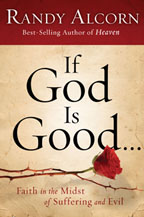
Endorsements of If God Is Good
In If God Is Good, Randy Alcorn goes where only brave men tread. With trademark humility and with a gentle, pastoral tone, he offers encouragement to those who suffer, wisdom to those who have not yet faced suffering, and a firm challenge to the skeptic. He shows that faith in the promises of God and better, faith in God himself, is what will sustain the Christian through suffering and evil. This book offers a depth and a pastoral quality that set it apart. I give it my highest recommendation.
— Tim Challies, www.challies.com,www.discerningreader.com
Few books have the ability to inspire and admonish, convict and challenge, compassionately touch the heart and biblically educate, all at the same time. Not only does Alcorn’s book do this, but it is also full of touching stories of the challenges, struggles, and triumphs of suffering saints. It contains valuable and easily understood doctrinal information that is significant for biblically interpreting suffering and the issues it raises. I am requiring If God Is Good for my course on “A Biblical Theology of Suffering, Disability and the Church” here at Dallas Theological Seminary.
— Dr. Larry J. Waters, Associate Professor of Bible Exposition, Dallas Theological Seminary
Questioning God's concern when tragedy happens is a normal human reaction and understandable passage of grief (just as I did when my brother Wieland was killed in 1970 in the Vietnam War). I learned back then it’s OK to doubt the Almighty, but staying there is definitely a dead end. If you feel stuck in your personal pain, I would encourage you to read my friend Randy Alcorn's book If God is Good—a genuinely encouraging reading that embraces struggle and offers real answers that help.
— Chuck Norris, Actor and Author
(originally printed in Chuck Norris’s WorldNet Daily column, September 15, 2009)
If God is Good is a treatise on theodicy, yet written for the common reader. It fed my hurting soul with its logic, and most importantly with its constant reminder of Jesus and the Father’s goodness and love for me in my fractured world. It should be in Bible and Seminary classrooms, as well as gifted to every hurting Christian and seeker who has been crushed (and many times embittered) by life’s sometimes terrible circumstances. This is Randy Alcorn’s best and most important work to date. This isn’t just a home run, it’s a grand slam.
— Jim Swanson, Tyndale Publishing Senior Editor of Bible and Bible Reference
I have read just about everything Randy Alcorn has ever written. He is one of my favorite writers. In If God is Good, he bravely tackles one of the most difficult questions mankind has ever wrestled with. I found this book to be absolutely enlightening and encouraging. Thanks, Randy!
— Jeff Foxworthy, Comedian and Actor
I am so grateful that another new generation of readers will now, with If God is Good, glean a clearer understanding of the relationship between God and the suffering He permits. We will certainly be recommending it to the many families affected by disability we reach through our ministry.
—Joni Eareckson Tada, Founder of Joni & Friends, www.joniandfriends.org, Author of When God Weeps
The next generation is fortunate to stand on the shoulders of men like Randy Alcorn, who addresses life's biggest questions with biblical wisdom and a pastor's heart. Firmly grounded on the rock of Scripture, If God is Good provides young and old with a solid place to stand amidst life's biggest storms. Future generations will count us blessed to have read this book hot off the press.
—Brett & Alex Harris, Authors of Do Hard Things: A Teenage Rebellion Against Low Expectations and Founders of The Rebelution: www.therebelution.com
If God is Good is biblical, thorough, clear, humble, confident, honoring to God in Christ, and extremely valuable to strengthen our faith in God's goodness, without pretending to erase the mystery of finite creatures with fallen flesh living by faith in a fallen world.
While the book is comprehensive, it is arranged according to key questions, so the reader can hop around. Once you start doing that, you'll be hooked to read the rest.
This book focuses us on our faith relationship to God in Christ, instead of simply seeking philosophical or apologetic answers, though those are gained while we focus on the greatness and goodness of God.
—Larry Gadbaugh, CEO Portland Pregnancy Resource Centers
When I pick up a book by Randy Alcorn, I know I'm about to be better educated, highly challenged, or richly rewarded—or, more likely, all three. Whether he's crafting a riveting novel or articulating an in-depth look at the truths of the Christian faith, Alcorn is one of this generation's premier Christian wordsmiths.
If God is Good is insightful, incisive, and instructive. Recognizing the value of story and anecdote, Alcorn uses them as devices to bridge the mental gap we often have between concrete and abstract.
He helps us to grasp truth by illustrating it with real struggles of real people. It's this human element that Alcorn uses to make this book so strong, so captivating, so practical for all of us who have been devastated by loss, pain, or evil.
—Randall Murphree, editor, AFA Journal
With over one million abortions each year, prolifers are keenly aware of evil and suffering in the world. Randy has tremendous insight and help for anyone who is struggling with the question of "why?" I found this book to be spiritually helpful and very encouraging.
—Gayle Atteberry, Executive Director, Oregon Right to Life
I can’t put down If God is Good. I can’t think of a book I’ve enjoyed reading more. It’s phenomenal!
— Keith Krell, Pastor
Book Reviews of If God is Good
It’s an old question, and the one question that reportedly kept Albert Einstein from becoming a Christian: “If God is good, then why does evil exist?”
Randy Alcorn has written a new book, If God Is Good, and I would urge you to pick up a copy. If you’ve never asked this question yourself, you’re bound to know someone who has. Randy explains things in a simple, easy-to-read format, but his answers are biblical, well-researched, and deeply profound. Learn how to take God’s word and apply it to what appears to be a most perplexing conundrum.
—Angela Hunt
This review originally appeared on Angela Hunt’s blog, September 12, 2009.
I just finished Randy Alcorn’s book, If God Is Good: Faith in the Midst of Suffering and Evil, and I recommend it. It’s quite long, but the chapters are brief and readable, so it’s not difficult to get through—although you could spend plenty of time thinking through the ideas of each chapter after reading them.
One thing I’ve been struggling to come to terms with the last few years is the sheer weight of all the evil and suffering in the world. Is good really stronger than evil? I certainly knew in my head that goodness—that God—is stronger, but evil seems so intensely powerful, and a little bit of it can destroy much good. I wanted to truly know and trust that good is even more powerful, has more weight, than evil—and not just at the end of time when God puts an end to evil by force.
I found myself picturing goodness as a wimpy little guy who can do nothing to keep himself from being stomped on by bullies. I knew that image was wrong—that it was even an insult to God, but I couldn’t shake it.
But this book has made a big difference. Reading a large amount of it over a short period of time overwhelmed me with story after story of Christians who suffered horrific evils…evils that were used by God to accomplish great goods—not only in the character of these Christians, but in their relationships with God and in the salvation of countless others. As painful as it was, the evil never succeeded in having the last word. The outcome was always God’s intended outcome.
I think I’ve been looking at this all the wrong way. I was measuring the strength of goodness by looking for good to put an end to evils, when all along, the evils were being used strongly by God for good. It’s hard to imagine thanking God for a painful life of paralysis, but people do. People do! Isn’t that incredible?
They’ve learned the secret: God has power over all evil that would seek to destroy, and it will all work to serve God’s good purposes.
Of course, that is where faith—trust in God and His character—comes in, because we can’t always see what good is being accomplished through any one person’s suffering. Sometimes it takes years to see, and sometimes the answer is beyond us in this life. But the avalanche of very specific stories in this book gave me hope like nothing else. Seeing God’s goodness and faithfulness in the lives of those whose level of suffering will probably far exceed mine in my lifetime, and seeing the resulting depth of their knowledge of and trust in God, changed something in me.
God’s goodness is more powerful than evil. Hallelujah!
—Amy Hall
This review was originally posted on the Stand to Reason blog
In If God Is Good, Randy Alcorn (author of Heaven, which has sold nearly half-a-million copies) addresses the ancient question, “Why would an all-good and all-powerful God create a world full of evil and suffering?” The question is not only ancient but current as well. The “new atheists” such as Richard Dawkins and Christopher Hitchens answer the question simply: The existence of suffering and evil proves there is no God.
Of course, most of us face this penetrating question not simply from an academic perspective but from a profoundly personal viewpoint. Because of this, Alcorn wisely blends deep theological insight, relevant apologetic wisdom, and compelling narratives from his conversations with men and women whose lives have been torn apart by suffering, and yet whose faith burns brighter than ever. Explaining his method, Alcorn says, “Though I write personally, from the heart, and tell stories of great courage and perspective, I must also present a case from Scripture and appeal to logic” (p. 3).
Readers of Heaven and of Alcorn’s blogs and resources at Eternal Perspectives Ministries will not be surprised to learn that Alcorn hinges his answer to the question of evil and suffering on the big picture of who God is and what he is doing in the world—now and forever. Those familiar with Alcorn also will not be surprised by the copious quoting, discussing, explaining, and applying of Scripture.
Some readers, especially those in the throes of suffering, may be taken aback initially by the length of the book. It is quite the tome at more than 500 pages. Alcorn addresses this in the introduction by empathizing with his readers and their need for comfort from a spiritual friend, pastor, or counselor, and by his exhortation:
But in the process don’t seek comfort by ignoring truth. When you try to soothe your feelings without bothering to think deeply about ideas, you are asking to be manipulated. Quick-fix feelings won’t sustain you over the long haul. On the other hand, deeply rooted beliefs—specifically a worldview grounded in Scripture—will allow you to persevere and hold on to a faith built on the solid rock of God’s truth (3).
For some in the midst of suffering, the length and depth of the book may still be a little much. They may want to read Alcorn’s The Goodness of God: Assurance of Purpose in the Midst of Suffering (Multnomah) which is in a gift-book format and weighs in at an easy-to-digest 120 pages. Additionally, Alcorn offers an intense, interactive study guide for If God Is Good (less than 200 pages, also by Multnomah).
At heart, Alcorn is a theologian—a practical theologian of pastoral theology—in the pattern of the great Puritan soul physicians. What we find in If God Is Good is nothing less than a biblical theology of suffering—a biblical sufferology. In section one, Alcorn deals with the issue first from a philosophical perspective—why is the problem of evil and suffering so important? What are some of the possible responses to the problem?
In section two, he addresses the problem theologically, starting with creation and fall—evil’s entrance into God’s perfect universe. Sections three and four return to a more philosophical and apologetic mode as Alcorn probes how non-theists attempt to explain the problem of evil—and why their explanations fall flat. By now at nearly 200 pages, you might think that Alcorn is too deep—perhaps too heavenly minded to be any earthly good. Not so. Throughout these “deep” sections and their corresponding chapters, Alcorn weaves personal stories, uses illustrations from classic literature and current cinema, and writes in an accessible and inviting style. Heavy stuff, yes. But worth the meaty diet.
The bulk of the book then runs from sections five through ten, some 250 pages. Alcorn now moves from creation and fall to redemption as he traces a Christ-focused, gospel-centered theology of evil and suffering and the redemptive purposes of God. If you had only one section to read, I would recommend section five: Evil and Suffering in the Great Drama of Christ’s Redemptive Work. Alcorn sets the problem of evil in the context of the grand narrative of God’s eternal purpose. He asks the question I’ve asked several nonbelievers, “If you were the author, how would you have written the story?” Alcorn next offers the only answer that truly matters: Jesus. As Alcorn puts it, “Jesus: The only answer bigger than the questions.” In the spirit of Martin Luther, Alcorn assures us that only the cross of Christ and only the Christ of the cross can attest to a good God in a world gone bad.
Alcorn’s eleventh and final section gets more personal, addressing how to live meaningfully in suffering. At first glance, one might think these less-than-50 pages hardly seem enough. We might think, “Less than 10% of a book on suffering given over to ‘practical’ matters?!” That depends on how we define practical, doesn’t it? In Alcorn’s hands, with the many personal vignettes and consistent application of truth to life, all 500-plus pages are “practical.” This final section is simply more overtly so.
When life is bad, Satan whispers, “God is in control of everything. Life is bad. God must be bad, too.” Alcorn, in all candor and honesty, whispers back, “Yes, life is bad, but God is good. He’s good all the time—eternally so.” It is only with an eternal, big-picture perspective that we can ever manage to defeat the insidious whispers of Satan. Randy Alcorn’s If God Is Good offers a first-rate, deeply theological, and profoundly practical eternal perspective on the character and plan of God in Christ.
It seems a fair question, doesn’t it? If God is truly good, as Christians insist, then how can there be so much suffering in the world? Since ancient times this question has led skeptics to believe that God cannot, must not, exist. Even today’s so-called New Atheists show how little is really knew when they use the existence of suffering and evil as a linchpin of their arguments against God’s existence. Quite simply they say, “If suffering and evil exist, then God must not.” Yet though people have wrestled with this question and allowed it to drive them from the faith, many more have wrestled with it and have come to the conclusion that God does exist despite suffering. They have found that suffering is God’s invitation to trust in him and to hold out hope for a better world to come.
If God Is Good is the latest book from Randy Alcorn who is probably best-known for his last major release, Heaven, which has sold well over a half million copies in hardcover. From my experience, Alcorn primarily writes three types of books: novels, very small books and very large books. If God Is Good, like Heaven before it, fits squarely in the final category. Weighing in at 512 pages, this is a good-sized hardcover that offers a thorough examination and defense of faith in the midst of suffering and evil.
The topic Alcorn deals with in this book is a particularly difficult one. Humility and practicality, trademarks of his ministry, are evident in the book’s earliest pages. “If I thought I had no helpful perspectives on the problem, it would be pointless for me to write this book. If I imagined I had all the answers neatly lined up, it would be pointless for you to read it.” He seeks to get right to the bottom of the subject and, as we learn, a sound theology of suffering touches upon many different areas. This leads him into theology that is increasingly foundational, plunging into deeper and deeper waters. He looks to the source and nature of evil, human depravity (advocating total spiritual inability), free will (arguing for compatibilism), divine omniscience, omnipotence and omnibenevolence, the existence of Heaven and Hell, justification, sanctification and so on. What area of the Christian life remains untouched by this great question of suffering? In what area of life or theology is evil not an unfortunate consideration?
Throughout the book Alcorn’s style is stridently didactic, bearing shades of Heaven. But where Heaven depended heavily on questions and answers, If God Is Good leans upon bolded headings followed by explanations. The style is unique in all the books I’ve read, but quite effective. These are headings that cannot be skipped over as they are integral to the flow of the book. So choosing a page at random, we see a heading of “Free Will in Heaven.” Immediately below that is a bolded sentence saying, “Free will in Heaven will not require that we be capable of sinning or that humanity may fall again.” There follows seven or eight paragraphs of explanation and then another bolded sentence to delineate the next few paragraphs: “We will have true freedom in Heaven, but a righteous freedom that never sins.” And so it continues throughout. This writing style fits well with the way I learn, though I did discover to my chagrin that I tend to skip over headings and often had to backtrack to ensure that I was not missing important content.
As we would expect, Alcorn’s teaching is interlaced with stories of grace through suffering. Some of these come from the author’s own life (consider reading this article if you have never read of some of Alcorn’s own suffering) while others come from family or friends or strangers. More than supplementary material, these examples show how God has acted in grace toward his people as they have suffered. Though the size of the book may warn some away (then again, this has certainly not proven the case with Heaven) the book is in no way an academic treatise. To the contrary, it is written with a general audience firmly in mind and, because it never gets bogged down in detail, anyone should be able to read and to enjoy it. In fact, though the book does teach some profoundly important theology and though it is concerned with doctrine, it is always pastoral in its tone. This is not theology for the sake of theology, but theology that brings true peace and comfort. Where firmness is required, Alcorn provides firmness, but where gentleness is best, he is gentle.
Writing to those who may see little need to read such a book he says, “We shouldn’t wait until suffering comes to start learning about how to face it any more than we should wait to fall into the water to start learning how to scuba dive.” To those skeptics who are convinced that the existence of suffering must mean the non-existence of God he challenges, “This is one of the great paradoxes of suffering. Those who don’t suffer much think suffering should keep people from God, while many who suffer a great deal turn to God, not from him.” And for those who know suffering all too well he encourages, “Our present sufferings are a brief but important part of a larger plan that one day will prove them all worthwhile.”
There can be a fine line between exhaustive and exhausting. In the case of If God Is Good, Alcorn has succeeded in writing a book that is long and thorough but not at all tiresome. And though this book enters quite a crowded field, it offers a depth, a thoroughness, a pastoral spirit that set it apart. I very much enjoyed reading it and trust that you will too. I am glad to give it my highest recommendation.
—Tim Challies
This review originally appeared on Tim Challies’ website: http://www.challies.com/ September 15, 2009.
I just finished If God is Good. It is a veritable treatise on theodicy, yet written for the common reader. It fed my hurting soul with its logic and information, and most importantly with its constant reminder of Jesus and the Father's goodness and love for me in my fractured world. It should be in Bible and Seminary classrooms, as well as gifted to every hurting Christian and seeker who has been crushed (and many times embittered) by life's sometimes terrible circumstances.
Finally, there simply must be small booklet portions created, with the larger book’s message condensed, as a handout for chaplains, pastors, and friends, etc., to hand out to the hurting and stunned by life's tragedies. This would complete the book’s mission in my judgment.
Randy, it is your best and most important work to date. I know just how much effort these books are. But it paid off; the book is “a round third and trot home grand slam.”
— James A. Swanson B.Th., M.S.M., M. Th.
In my ministry career there have been a handful of events that have occurred where I had to completely throw out my lesson plans for the week and deal with the fears and questions brought about each horrible incident.
After 9/11 I can remember sitting with the teens and college students in the class room—all of us seemed shell shocked and confused. “How could this have happened?”
After Katrina ripped into New Orleans and the Gulf Coast I gathered with some students in the gym as we tried to make sense of what we were witnessing on television. “What can we do?”
After the Virginia Tech massacre I struggled to help my students process through why something so senseless could have happened. “Why?”
Asking questions about evil and suffering when world events happen is one thing. But how do you deal with pain and hurt and cancer and evil and suffering and death when they strike closer to home?
Many have wrestled with the question: “If God is good why does evil and suffering happen?” As a minister, I wrestle with finding a resource out there that will help me walk alongside someone as they struggle through personal pain, agony, and questions. Unfortunately, finding the right resource has been next to impossible. There are just way too many mixed messages out there.
Typically books concerning the nature of evil and suffering in this world and whether or not an all-powerful God can do anything about it typically fall into three categories: 1) they are written from the perspective of an atheist and therefore write off any discussion about God and faith; 2) they are a sugary sweet devotional book that can be summed up with a pithy “Trust God and it will all work out” finale; or 3) they are deep philosophical treatises that often take readers, who are desperately seeking answers now, months to work through (if they finish).
If God Is Good by Randy Alcorn is decidedly much different and, rather than adhering to these categories, charts a brand new course. Alcorn does a tremendous job discussing the problem of suffering and evil in a way that is both personally engaging and full of scriptural integrity. This book is filled with personal stories of those who have been subjected to the worst that evil and death could throw at them. Some of these stories will tear your heart open. Make no mistake, this is no warm and fuzzy devotional book meant to rest on your bedside table. This is an engaging, thoughtful, well-researched, and challenging book that will give you answers and hope in the middle of whatever storm you are facing.
Alcorn finds his hope within the pages of scripture. He writes in the opening section that, as believers, we can deal openly and honestly with the problem of pain and suffering because God’s Word deals openly and honestly with it. He writes, “The Bible never sugarcoats evil.” Alcorn takes on false arguments, false gospels, and false expectations that all seek to distort, confuse, and destroy the faith of millions who face suffering and true evil. One recurring theme in his book is that it seems that those who have only dealt with suffering in the philosophical realm have walked away from their faith while those who have experienced real suffering draw closer to God and have found meaning and purpose in his loving arms.
As a resource, I love this book. Alcorn has meticulously studied this subject and each chapter includes generous footnotes. There is a helpful scripture index as well as a topical index that make this a user-friendly book about a most difficult subject. Every minister should read this book and keep it at close reach on their desk. Evil and suffering will strike sooner or later. With If God Is Good by Randy Alcorn you will be prepared to minister to those left in its wake.
—Michael Felker
This review originally appeared on MichaelFelker.com September 25, 2009.
In the author’s matchless style, he personalizes the question of suffering, with a name and a face...
Bestselling author, Randy Alcorn’s, new release, If God is Good, explores the age-old problem of evil and suffering when he asks, “If God is good...why all this evil and suffering?” Then adds, “What if suffering is God’s invitation to trust him?”
He explores a biblical perspective and explains that a different viewpoint doesn’t minimize suffering, but provides a position that equips sufferers to find encouragement and comfort in the arms of God.
Alcorn writes, “The faith that can’t be shaken is the faith that has been shaken.” He quotes 1 Peter 1:7 where God says trials and suffering come to test your faith—which is “of greater worth than gold.” He explores how God uses personal pain and suffering, often initiated by a crisis, to enhance faith and refine it like gold. He suggests instead of thinking of suffering as divine judgment, or proof there is no God, think of seasons of pain and suffering as tests that stretch our faith in God.
He also confronts atheistic arguments in chapter two. If God isn’t willing to prevent evil, He must be impotent, or if God is able to prevent evil, but not willing, that makes Him malicious. Alcorn’s search for perspective taught him, “...wisdom begins with the humility to say there’s a great deal I don’t understand,” and won’t this side of Heaven.
Forty-five chapters, organized into eleven topics, ask hard questions that few ministers attempt to answer. The book can either be read straight through, or topically for those with specific questions, which makes it particularly useful for Bible study. Even though the book tackles a difficult subject, Alcorn’s innovative writing style, is reader friendly, filled with insightful anecdotes, and personal short stories that put a human face on suffering. His focus is on Scripture and “our faith relationship to God in Christ.”
The author’s thorough and confident book includes how to find God, and seek His help and grace when we experience “dark times” of suffering. I believe it’s written with inspired wisdom and humility and offers readers the choice to become “bitter or better” in times of crisis. I consider this a must-read for anyone because we all experience seasons of suffering. If I could, I would nominate it book of the year for 2009.
—Gail D. Welborn
This review originally appeared on The Cypress Times website October 3, 2009.
Recently, as a pastor, I have had a lot people ask me questions about God, suffering, and evil. In such difficult times, suffering and evil beg questions about God—Why would an all-good and all-powerful God create a world full of evil and suffering? And How can there be a God if suffering and evil exist?
These are ancient questions, but also modern ones as well. Atheists such as Richard Dawkins, Christopher Hitchens, and even former believers like Bart Ehrman answer the question simply: The existence of suffering and evil proves there is no God.
In this captivating new book, best-selling author Randy Alcorn challenges the logic of disbelief, and brings a fresh, realistic, and thoroughly biblical insight to the issues these important questions raise.
Alcorn offers insights from his conversations with men and women whose lives have been torn apart by suffering, and yet whose faith in God burns brighter than ever. He reveals the big picture of who God is and what God is doing in the world–now and forever. And he equips you to share your faith more clearly and genuinely in this world of pain and fear.
As he did in his best-selling book, Heaven, Randy Alcorn delves deep into a profound subject, and through compelling stories, provocative questions and answers, and keen biblical understanding, he brings assurance and hope to all.
—Daryl Marrill
This review originally appeared on My bookshelf, Christian Life Church September 25, 2009.