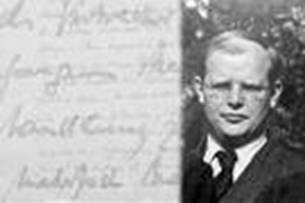
 Before we get to Bonhoeffer, I want to make some observations. If you want to shorten your read and move to the Bonhoeffer part, skip these first nine paragraphs.
Most of the feedback on my blogs has been positive, but I always welcome constructive criticism and disagreement. I really like to learn from input, and it’s not unusual for me to adjust my thinking as a result. My many years of being a writer (not to mention addressing the always-edgy prolife subject) have thickened my skin, and it’s rare that I feel defensive.
Since writing the political blogs, at first disagreeing responses were mostly reasonable, but now I’ve been getting angry responses, occasionally in the comments and sometimes in emails. Some Ron Paul folks (certainly not all—some have been very gracious) seem particularly irritated that I don’t favor their candidate, even though I researched him, read his own words and based my appraisal on his statements.
Okay, so we disagree. Do we have to be surly about it?
To everyone: please feel free not to support Mike Huckabee. I promise I won’t get mad at you. I won’t go to your blog and leave the same comments linking to the same articles again and again, and I won’t tell you I think your choice will make you responsible for this country’s ultimate destruction (as someone said my support of Mike Huckabee would do, which apparently makes me a pretty powerful person).
Some people are convinced that those who don’t support their candidate are all idiots. Well, we may in fact be idiots, but if we are, then you won’t change our little idiot brains by your sheer quantity of posts, repeating the same objections and posting the same website links.
A comment came yesterday calling me a “religious hypocrite” and saying, “stop hiding behind the abortion issue as if it's the only reason to cast a vote; wake up and smell reality.” Apparently they didn’t notice I said abortion is by no means the only issue. Just like Jew-killing was not the only issue in Nazi Germany. As I said, I’m very concerned about the poor and minorities.
However, I don’t know of any presidential candidate who is saying it’s fine to kill the poor and minorities. If I did, I would not vote for them under any circumstance.
But there are people running for president who are actually saying it’s fine to kill unborn children. And I’m simply not going to vote for any of them. Now, if that seems ridiculous to you, you’re entitled to your opinion (and accountable for it too, as I am for mine). And if my opinion makes you mad, well…please feel free to exercise your right not to read this blog.
I receive a fair number of emails from disgruntled people who descend from Mount Olympus just long enough to fire off their thunderbolts here in the land of lowly mortals, at those of us who just don’t get it. For what it’s worth, I rarely find outrage, name-calling and sanctimonious rudeness (whether it’s from conservatives or liberals makes no difference) to be persuasive. Not in political or theological discussions, or any other kind. It’s also interesting when these attitudes come from people who pride themselves on their tolerance and constantly condemn others for being judgmental. Calling people hypocrites when you don’t know them, and don’t have a clue what they may be doing for the poor and needy, is somewhat judgmental, don’t you think?
In contrast to those kinds of comments, I got an email this week expressing honest concerns about Dietrich Bonhoeffer’s theology. I really appreciated this. As I said in one of the blogs, I do disagree with Bonhoeffer in various areas. Theologically, as was nearly everyone in his place and time, he was certainly more liberal than I am. I don’t adhere to all parts of Bonhoeffer’s or Karl Barth’s or Martin Niemöller’s theology. But it should be understood that within the German church they were theological conservatives compared to the dominant liberalism of that day.
When he came to New York, Bonhoeffer was unimpressed with the liberalism of the professors at Union Seminary, but he was deeply touched by the simple gospel preaching and singing at a black church in Harlem that believed and taught the Bible. In fact, he later said that it helped him come to a genuine faith in Christ…after he’d already earned a doctorate in theology.
While I would not present Bonhoeffer as a model theologian in every area, I think 95% of The Cost of Discipleship is right on target. His personal love for Christ was evident in his books and in his life.
Someone wrote me that Bonhoeffer wasn’t put to death because he was a Christian, but because of his involvement in a plot to assassinate Hitler. That’s correct, in one sense, but in Dietrich’s case he came to his conviction to become involved in the plot after wrestling with his Christian conscience. Some believers think no Christian should ever be involved in such a plot. But given the extreme circumstances of Hitler’s ongoing slaughter of millions of innocents, might we see things differently?
If I see a man with a gun about to kill a child, am I right to use lethal force against the man to prevent the killing of that child? I think so. What about preventing the killing of millions? Not a day went by without Hitler making decisions that killed countless people, not only those in concentration camps, but his own German soldiers and citizens.
Bonhoeffer was driven by his convictions as a Christian. Now, the Nazis were fine with anyone saying they were a Christian as long as they didn’t interfere with the Nazi agenda, including the Holocaust. But if you opposed Hitler, as Bonhoeffer did in his role in the Confessing church and teaching at the illegal seminary, they would take away your civil liberties.
Bonhoeffer wrote to Erwin Sutz on September 11, 1934, “We must finally stop appealing to theology to justify our reserved silence about what the state is doing—for that is nothing but fear. ‘Open your mouth for the one who is voiceless’—for who in the church today still remembers that that is the least of the Bible’s demands in times such as these?” Bonhoeffer was not first and foremost an assassin. He resisted Hitler peacefully for nine years before getting involved in an assassination plot, and only then after being shown the visual proof of what was being done to Jews in the concentration camps. So I would not make too much of the notion that Bonhoeffer didn’t die because of his Christian convictions or actions. His illegal actions against Hitler and the state arose out of his Christian conscience.
Let me mention another great resource, Dietrich Bonhoeffer: A Life in Pictures, Centenary Edition. It contains some fascinating photographs and tells his story in short commentary surrounding the pictures. I’ve just spent a few hours in it and am more than half way done.  While at Tegel Prison, Bonhoeffer was able to have books left for him, often by his fiancé Maria von Wedemeyer, shown here. Maria would bring him clothes and blankets—once even a Christmas tree—to the prison, and he was able to send and receive a letter every ten days. Later, after he’d been moved to Buchenwald, and it was bombed by the allies, she drove from prison to concentration camps, trying to find him. She never did. Great as their love was, they would never be married, nor see each other again in this life. Maria didn’t even know he’d been killed until two months after the war. Theirs was a tragic love story.
I spoke last week of how the German church, both Catholic and Protestant, capitulated to the Nazis. This is why Bonhoeffer, Karl Barth and Martin Niemöller, among others, found it necessary to form the Confessing Church, which did not submit its beliefs and practices to the Nazi party or the German state.
The church’s failure in Germany wasn’t unique to that country. Some American churches are so America-centered they cannot stand apart from America, as citizens of a heavenly country, to challenge or rebuke or change America. They become so indistinguishable from America, so incapable of identifying her failings, that they have little to offer her except adoration.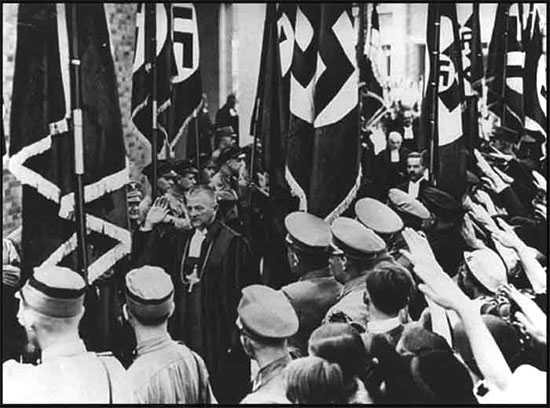 There’s certainly a place for patriotism. A Christian can be proud, as I am, of many things about his country. It’s okay to be a proud citizen of America, Germany, or any nation. The athletes’ love for their mother countries is one of the things I enjoy about the Olympics. Christians of very diverse nationalities can serve our countries and pray for our leaders. But only Christ should receive our primary loyalty and unconditional obedience. We dare not allow our identity as Americans to eclipse or confuse our identity as Christ’s disciples.
The prohibition “you shall put no other gods before me” does not just mean gods made of wood or metal. A country can become a false god. Note how the cross hangs around the neck of the German Reich bishop Mueller in this picture, while he walks under the Nazi flag. There is powerful and horrifying symbolism here of the cross subjugated to the flag. In fact, Christ does not bow His knee to any earthly nation, and as His followers neither should we.
If Christians do not judge their nation in the light of Scriptural principles, they will inevitably interpret the Scriptures in light of national policies. That’s exactly what Bonhoeffer saw happen in Germany, with tragic results.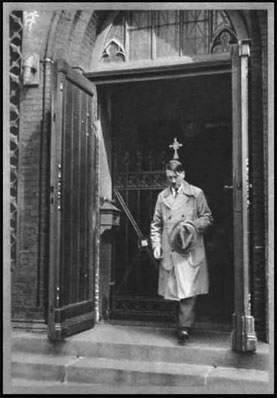 Consider this picture of Hitler attending church, walking out with the cross above him. When American politicians make their appearances in churches, or use God-words, we should not assume that they are true followers of Christ. Some of them are, but words are cheap, and public appearances may serve their agendas and not Christ’s. The German Christians, by failing to repent of and correct their country’s pride and militarism and violations of human rights, utterly failed the country they professed to love. Likewise, Christians who love America more than they love Christ, who equate the flag with the cross, will worship an American Christ (who is therefore a false Christ, since Christ is not American). In doing this they disqualify themselves from truly helping America and do their country a terrible disservice. An American Christian who fails to bring biblical truth to bear upon America becomes a traitor to America.
I’m told that even today German society retains a profound distrust for the Christian church. Why? Because the German church betrayed Germany by failing as a whole to rise up and speak prophetically against the German state.
The Greek city of Philippi was declared a Roman colony by Augustus after a great victory there. The Philippians were extremely proud of their Roman citizenship. It’s no coincidence that it was the Philippian church to which Paul said, “But our citizenship is in heaven. And we eagerly await a Savior from there, the Lord Jesus Christ” (Philippians 3:20).
We are to follow the example of Abraham and others of God’s people: “They admitted that they were aliens and strangers on earth. People who say such things show that they are looking for a country of their own…Instead, they were longing for a better country—a heavenly one. Therefore God is not ashamed to be called their God, for he has prepared a city for them” (Hebrews 11:13-16).
Bonhoeffer did what God’s people in any country at any time should be willing to do: stand up for the true Jesus, the only Savior. Jesus, God’s Son. Jesus, the Jew. They should speak up for the disadvantaged, who God loves. In Germany, that included the Jews. In America, that includes the poor, disabled, those suffering from racial discrimination, and unborn children, who cannot defend themselves against the atrocities of today’s death camps, the abortion clinics. (It is always far easier to see the bloodshed of another country of another time and wonder why the Christians didn’t stand up, than it is to see the atrocities of one’s own place and time, where we are failing to stand up.)
Unborn children in America are our equivalent of Jews in Germany sixty-five years ago. The church’s indifference to them, and failure to stand up in their defense, is a shame of huge proportions. Self-righteously we decry the German church’s failure to stand up for the Jews. Meanwhile we fail to stand up for the unborn. We shake our heads in disgust at the German church’s tolerance of one holocaust while ignoring our own tolerance of another.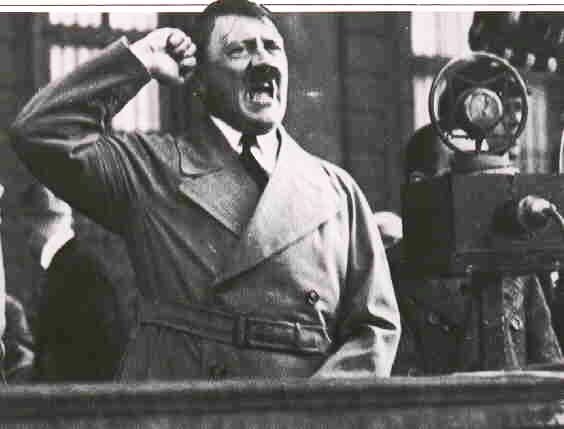 In 1933, three years before Bonhoeffer wrote The Cost of Discipleship, Adolph Hitler became Chancellor. In that documentary I recommended last week there is a newsreel of Hitler standing before the German people, sounding like a preacher. In the translated subtext of his message Hitler promised “the resurrection of the German people,” and “the salvation of the homeland.”
Three days later, as Germany and many of her churches were still celebrating Hitler’s ascent, twenty-seven-year-old Dietrich Bonhoeffer spoke on the radio. He warned against a worldly leader making an idol of himself and his office, thereby mocking God. Bonhoeffer entitled his message, “Christ is Our Fuhrer.” He was halfway through it when the Gestapo cut off the transmission. A year later, he wrote to a friend, “Hitler has very clearly demonstrated who he is, and the church must know with whom it has to reckon.”
From the day of that radio broadcast, the young theologian would be a thorn in Hitler’s side. Twelve years later, with the Allies moving in on Berlin, Heinrich Himmler, acting on Hitler’s behalf, ordered Bonhoeffer’s execution, less than a month before the war’s end. Bonhoeffer asked a British prisoner to communicate a message to a friend in England, George Bell. These were Bonhoeffer’s final known words: “This is the end; for me, the beginning of life.”
Stripped naked, Bonhoeffer was led outside to the gallows. The author of The Cost of Discipleship would pay the price he wrote of. “When Jesus calls a man,” Bonheoffer wrote, “he bids him come and die.”
The Disciple and the Fuhrer died in April 1945—Bonhoeffer on the ninth, Hitler on the thirtieth. Exactly three weeks apart, both men faced God.
I believe that Dietrich Bonhoeffer, a moment after his death, heard his Lord say to him, “Well done my good and faithful servant; enter into your Master’s joy.”
Adolf Hitler, a moment after his death, heard something very different.