It’s been a couple of weeks since I’ve posted pictures of our grandchildren, and I’ve received countless emails encouraging me to get back to doing so. (Okay, there was one email, which I wrote to myself.) Here are the boys, at a barbecue on our deck last week.
Here’s Matthew at a park we went to Sunday evening, which I hauled him to behind my bike.

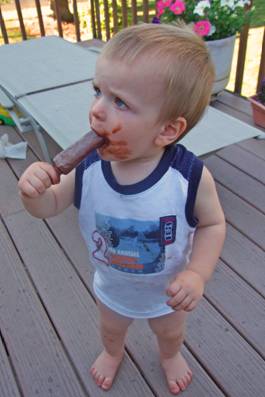
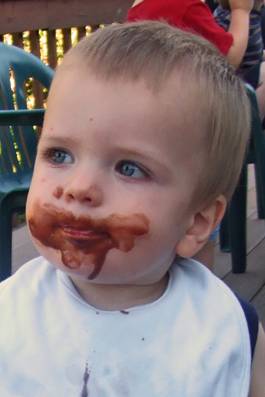
Ty was very fond of his popsicle.
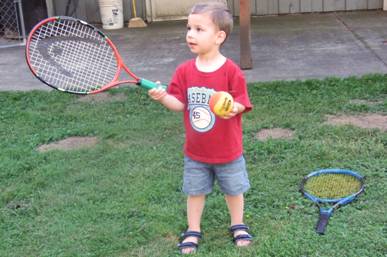
Here’s Jake in our side yard, getting a head start on the great sport of tennis.
Okay, now for a young person to whom I’m not related: Harry Potter. You may have heard of him.
The popularity of the Harry Potter books defies comparison: 325 million of the books have been printed worldwide, in sixty-six languages, with an estimated readership of 500 million.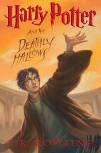 Scholastic’s first US printing of the new Deathly Hallows, released last week, was an unprecedented twelve million copies. Over eight million copies sold in the first 24 hours. A newscaster said the other night that five thousand Harry Potter books are being sold every minute in the United States.
On the positive side, the books are well written and engaging, and the characters are likeable. I love that kids are looking away from video games and television and computers and their ipods and phones long enough to actually read. Of course, that raises the issue of what it is they’re reading.
Some object to Harry Potter on the grounds of violence and disrespect for adults. Others point to the moral ambiguity of the stories, believing that even the good characters are poor role models for their children, in that they sometimes lie and steal (or even kill), and get away with it. But in the portions I've read (one whole book and a couple of parts of others) I think there are a lot of positive moral elements too.
My biggest concern about these stories is the benevolent portrayal of the occult, and the implication that there is good witchcraft and positive magic accessible to people, particularly children, here on earth. That's why I can like certain aspects of Harry Potter, including his friends and the author's values of courage and loyalty, but still be concerned about the influence on some children.
Deuteronomy 18:10-12 says, “There shall not be found among you anyone who makes his son or his daughter pass through the fire, or one who practices witchcraft, or a soothsayer, or one who interprets omens, or a sorcerer, or one who conjures spells, or a medium, or a spiritist, or one who calls up the dead. For all who do these things are an abomination to the LORD, and because of these abominations the LORD your God drives them out from before you.”
When I look at my grandchildren, am I concerned for them and their generation, that some will direct their spiritual interest toward the darkness of witchcraft, spiritism and magic? Yes, I am. It is not my ONLY or even primary concern for young people today. But it is certainly one concern.
Does Harry Potter do anything to cultivate interest in the false religions of Wicca, Paganism, and Neopaganism? To most people, maybe not. But what if it only affected 10% of readers this way? That would be fifty million. Let’s say it’s just 1% percent of Harry Potter readers who are made more likely to embrace or see as harmless witchcraft or sorcery, mediums or spiritists, or the conjuring of spells which God’s Word utterly condemns and warns against. Well, so far that would be five million people.
I have great Christian friends who can’t understand why I or anyone would have concerns about Harry Potter. (The fact that they can’t understand it reinforces my concerns.) They say, “Don’t you get it? These books aren’t real. They’re just fantasy!”
Well, OF COURSE they’re fantasy. But please don’t demean the power of fiction and fantasy and story by applying to it the impotent adjective “just”, any more than you would minimize lightning or the ocean or a pack of wolves by calling it “just” lightning, or “just” the ocean or “just” a pack of wolves. (It’s like if Nanci asks me, “What’s that noise in the back yard?” and I look out the window and yawn and say, “It’s just a pack of wolves; oh, and they’ve made a circle around Moses [our dog].”)
Fantasy has the power to deeply engage and influence. I know. As a sixth grader I subscribed to Fantasy and Science Fiction magazine. I loved fantasy, and still do. I vividly remember exploring things I’d read about in fantasies. I once read something about the occult and took out my Ouija board (that’s another story) and sought to make contact with spirits. Thankfully nothing happened.
But if I had read an entire series of books celebrating and sugar-coating magic and witchcraft and casting spells, would it have made me open to the dark powers of the occult? Sure.
Harry Potter is a series of much-loved books written for impressionable young people, many of whom will become open to much of whatever the very likable Harry is into. How could it be otherwise? I mean if Harry liked fried green tomatoes, don’t you think some kids who otherwise wouldn’t have are going to try fried green tomatoes?
Now don’t get me wrong. Judging from her interviews I’ve seen, I think J. K. Rowling is very nice and likable. She seems to genuinely love children and comes across as gracious and humble. Frankly, I’d rather spend time with her than some people I know who hate her books. (By the way, I'm bending over backwards here because in my experience as soon as you offer any criticism of Harry Potter you are labeled by some a book burner. So let me emphasize that I'm not talking about banning or burning Harry, only exercising discernment in light of the positive depictions of witchcraft, something God's Word considers negative.)
If Rowling is not a follower of Jesus, I’d be delighted if she became one. If she is His follower, as a number of Christians are now claiming, I’d hope she would grow in her faith and look for ways to speak up for Jesus. I'd also hope that she would speak out against the dark side of the occult, and warn children not to think that in the real world it is harmless.
I just read an article by a Christian defending Harry Potter on the basis that J. K. Rowling does not believe witchcraft is real. Well, if that’s true, then J. K. Rowling is wrong. It IS real. And it is explicitly condemned in Scripture in the strongest possible terms.
I read another article arguing that the final book is distinctively Christian. The article's author says that a fitting verse for the book would be “greater love has no man than this, that he lay down his life for his friends.” He claims that Harry’s mentor, the headmaster of the school, represents God the Father, and Harry Christ the Son. One gets the feeling he expects to be hearing endless testimonies of “I came to Jesus reading the Harry Potter books.”
Please. Defend these books if you believe you should, but don’t turn them into Pilgrim's Progress!
Personally I wonder how much of the book’s redemptive themes, including shed blood, are explicitly Christian, and how much is just the intersection of Rowling’s skillful writing with the greatest story of all, the prototype redemptive story of Jesus. Good stories must be redemptive. This doesn’t make them the gospel!
Won’t some kids get the message that all those ordinary people (Muggles) who don’t think witchcraft is good are narrow-minded and judgmental? Won’t some follow Harry’s example and see if they can get in touch with supernatural powers inside them or outside?
Let me be emphatic here: I'm not saying that no Christian should read these books or watch the movies. I'm just saying, be wise. Use discernment. Understand that while YOU may not be in danger of being desensitized to the evils of witchcraft, the world does not consist only of YOU. There are other people, particularly young people, who are vulnerable to the occult, and for some of them--not you, and not all--Harry Potter could serve as a gateway. In my childhood, I was seeking for the supernatural years before I heard about Jesus. I could easily have gone another road, and with a little different stimuli, I likely would have.
There are bandwagons galore among Christians: “Harry’s horrible” and “Harry’s great,” “Harry’s Satanic” and now “Harry’s Christian” and “Harry’s a Christ figure.”
I think we should stay off ANY bandwagon. We should search the Scriptures daily to see what’s true (Acts 17:11). In my opinion, when you search Scripture and see how it views human beings exercising or seeking to exercise supernatural powers from sources within themselves or outside themselves, but not from the one true God revealed in Scripture, then you will understand why some Christians are concerned about Harry and his impact.
I know there are many AVID Harry Potter fans who are Christians. (Some reading this blog will be among them.) I know they’re amazed and sometimes angered at Harry critics, thinking “you just don’t get it; this stuff is harmless and innocent, and why are you concerned about this when kids are on drugs and in gangs?” (By the way, I AM concerned about drugs and gangs.)
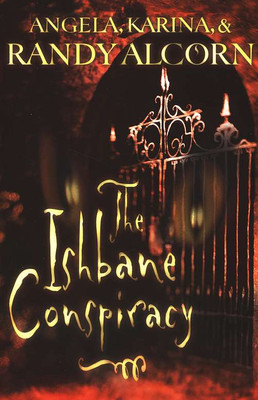
This is something I wrote years ago concerning Harry Potter. It begins with a letter from a sincere Christian who loves the Harry Potter books, thinks Harry is no different than Tolkien's Middle Earth or Lewis's Narnia, and could not understand how anyone could criticize HP. I follow with my answer, then throw in some first draft dialogue my daughters and I mostly cut out from a novel we wrote together, The Ishbane Conspiracy. The passage was cut because it was too agenda oriented and didn’t further the plot. But the dialogue does reflect realities which in my opinion continue to have merit.
When was the last time I heard of a young person go into the occult as a result of reading Harry Potter? Three days ago. Unsolicited, someone told me of a teenager obsessed with Harry Potter, who has gone on to be part of Wicca, an organized group of witches. Now, might she have done so without Harry? Yes. But did Harry encourage her to explore the occult? In the opinion of her parents and those who know her, the answer is yes.
When you have actually seen young people drawn into the occult (a very real and very dark and destructive world) by what they read, you are sensitized to this. This is why I would ask that the concerns not be dismissed, even when they are overstated. Regardless of how the series ends (I read the ending the other day), some of us continue to have concerns about both the worldview and the impact of this series.
This should not be dismissed as over-reactive fundamentalism or quick-to-condemn legalism that has now been proven wrong because the author professes to be a Christian and the book includes some redemptive elements. On the contrary, a genuine concern not only for God’s truth, but for the hearts and souls of people, is behind many of our concerns about Harry Potter and similar books.
One thing we can agree on is that history has clearly proven Christians are not going to agree concerning Harry Potter. :) I appreciate our willingness to listen to each other, and at the same time ultimately go to Scripture and listen to God.
There is a need here to be like Jesus, full of grace and truth. Not truth instead of grace, or grace instead of truth, but both. Regardless of our different positions on this, hopefully we can also agree that it is His appraisal not only of Harry Potter, but of everything else, that ultimately matters. (And His appraisal is best discerned through the study of His Word, not by the current drift of popular opinion on one side or another, whether inside the church or outside.)
Okay, this blog’s done. But next blog I’m going to quote two writer friends of mine, Sarah Anne Sumpolec and Ann Tatlock. I have asked their permission to publicly post their own experiences and perspectives, originally in private emails, related to Harry Potter. I think you’ll find Sarah’s story, and both Sarah and Ann’s insights, fascinating.
As for the endless comparisons to Lewis’s Narnia and Tolkien’s Middle Earth (I cringe whenever I hear Christians do this, and it’s constant), I think they’re way off base. Lewis and Tolkien created other worlds, with their own orders of beings. But Harry is a child/teenager living on planet Earth. No child reads Tolkien and makes it his life goal to become an elf or a dwarf. Nobody reads Narnia and attempts to become a talking beaver or a unicorn. The magic in Narnia operates by certain principles in that foreign universe, and it is not for this one. And if some child bruises his forehead trying to go through the back of his closet to find Narnia, I’m sure he’ll get over it.
In contrast, Harry Potter is a real kid (fictional, of course, but real in the sense of human, like Tom Sawyer) who lives on the earth. And part of that real world the reader shares with Harry is something called witchcraft and magic and supernatural powers with a dark side. There are real people in the real world who are into these things, and they have real websites kids can visit and meetings real people attend.