


 Abundant: Experiencing The Incredible Journey of Generosity
by Todd Harper
In 1989 I wrote my first book on financial stewardship, Money, Possessions and Eternity. Since then I’ve updated that book and have written The Treasure Principle and Managing God’s Money. Giving is a topic I’m passionate about. I consider it part of my life’s calling to encourage God’s people to have an eternal perspective when it comes to their finances. That’s why I’m delighted to write the foreword to this book.
I first met Tod Harper in the late 1990s along with Daryl Heald, David Wills and Forrest Reinhardt, the other founders of Generous Giving. To this day I deeply appreciate all of these leaders. I had the privilege of speaking at the first several Generous Giving conferences and saw the ministry close-up in its infancy. Since then I’ve spoken at a half dozen other Generous Giving gatherings. I’ve also been part of a Journey of Generosity in a private home. I love the Generous Giving organization, and it’s been gratifying to see its impact go deep and wide.
This movement resonates with every fiber of my being. Glorifying God in how we used our money isn’t a duty; it’s a delight! Giving brings great happiness, and our happy God rejoices when our hearts celebrate. In the only statement of Jesus in the book of Acts that’s not in the Gospels, Jesus said, “it is more blessed [Makarios, happy-making] to give than to receive” (Acts 20:35). Yet too many believers never experience the overwhelming grace of God, which is the lightning that produces in our lives the thunder of giving, and a joy unlike any other.
To many, Todd Harper is the primary face and voice of Generous Giving. As president, he loves communicating a Christ-centered and joy-cultivating approach to giving. I’ve been with him in many places over the years and have seen him at work. Todd genuinely loves people and views them not a as means to the end of funding good causes, but as those whom God has created and gifted who can use encouragement in the journey. This book is a reflection of Todd’s heart and values.
In Abundant Todd explores the challenges of wealth, deeply familiar to him through his years of working with successful leaders and their families. He provides a plan to help break down the isolation and confusion that so often accompany material wealth. Through engaging in honest, low-pressure conversations, believers often discover they’re not alone in their struggle to grow in generosity. This is one of the most attractive aspects of Generous Giving, and it comes through in this book.
As someone who has never served in an official capacity with the ministry, but who has seen it firsthand since its beginning, I can say without question that God has used Generous Giving, and continues to do so under Todd’s leadership, to reach people with a vitalizing message that has forever changed families, churches, and the work of Christ around the globe. As a facilitator of deep, heartfelt, and joyful conversation about giving, this ministry helps people discover that God’s plan for their money can be liberating and full of happiness!
Todd and the Generous Giving team have cultivated a culture in which hundreds of business leaders world-wide own the mission of Generous Giving, which is to spread the biblical message of stewardship in order to grow generous givers among those whom God has entrusted with much wealth. Hence, Generous Giving is growing through volunteers, rather than paid staff members. More Journey of Generosity retreats held each year are completely volunteer-hosted and volunteer-led, with peers engaging their peers, exploring God’s purposes for wealth through open and invigorating conversation. This isn’t simply one person’s message—it’s a powerful and beautiful movement of the Holy Spirit among His people.
Abundant invites you to take a closer look at this movement. The book is refreshing, engaging, and personal. Todd’s warmth allows the reader to be challenged without being threatened.
I long for Christ’s kingdom work to be funded at greater levels, but I long just as much for God’s people to experience the radical life-changing joy of giving done as an act of love for Jesus and others. May God continue to use this ministry, and use this book also, to that end.
by Kurt Nelson
My friend, Kurt Nelson, has written a succinct, penetrating, and powerful treatment on the Holy Spirit. It is remarkable in that it’s so drenched in Scripture that I can say a very large part of it is inspired and without error! Kurt’s part isn’t inerrant, but the close attention he pays to basing his words on God’s Words makes this not just one more opinion piece but a concise and authoritative treatment of the Person and work of the Holy Spirit, the most neglected member of the triune God. Most of us know far less about the Holy Spirit than the Father and the Son, but we need to see Him and His work with new wonder and appreciation. I highly recommend this book!
Come Away
by Shel Arensen
Foreword by Randy Alcorn
“My sheep listen to my voice,” Jesus said. Have you been listening to his voice lately? Have you been putting your ear to his Word and asking him to speak to you?
Have you been sitting at the feet of Jesus, as Mary of Bethany did, turning your back on a thousand distractions to enjoy the presence of your bridegroom, the Carpenter from Nazareth—the one who said he was going to prepare a place for you and coming back to get you so you can be with him forever?
We were made for a person and a place. Jesus is the person. Heaven is the place. We’ll never be satisfied with any person less than Jesus, and no place less than heaven. We won’t be fully content until we’re home with our Beloved. But the closest we can get to contentment-and to heaven—while we’re still here as aliens and strangers on this earth, is when we come away with Jesus and get away from his substitutes.
Shel Arensen is right on target when he says, “Whether we realize it or not, we desperately need to spend time with God.” Many of us realize it, but only sporadically. No sooner do we sense he’s the one we’re longing for, that he’s the cold refreshment for our parched throats, then we turn to lesser streams that cannot quench our thirst. We let that still small voice of God get buried under the din of our busyness. Television, radio, email, classes, sports, business trips, chores, hobbies. Up early, to bed late. Music turned up loud. Talk shows where we hear from everybody but the One who knows everything.
How does this all fit with “Be still, and know that I am God”?
John Piper says God is most glorified in us when we are most satisfied in him. We will only be satisfied with God if we go out of our way to spend special time with him.
In the spring of 1988, Nanci and I and our daughters, Karina and Angela, then only seven and nine, spent two weeks with Shel and Kym Arensen and their children in their home in Kenya. We’ll never forget those people or that place. We celebrated Easter in a large hut with backless benches, worshipping God for hours, delighting to the children as they danced to the music. We looked down over the great Rift Valley, and listened to the monkeys chatter in the trees over our heads.
Sitting here in my office in Oregon, I just turned my head to the left to see a picture I took there of a tall young Maasai woman and her child, who seemed to appear out of nowhere as we picnicked on a game reserve with the Arensens. We still have a Maasai spear in our basement.
We saw wildebeests and zebras, giraffes and gazelles, heard lions and saw hippo tracks outside our tent. Our four-wheeler was chased by baboons. (We found out later the Arensen boys were throwing cheese snacks out the sun roof.) We drove to the coast, to Malindi, where Shel warned us to run through the shallow waters into the Indian Ocean to avoid burning our feet. (In Oregon you run through ocean water for another reason—to keep your feet from getting numb!)
We saw insects so big they cast shadows. Early one morning our daughters looked at us wide-eyed and one of them said, “Daddy, there’s a giant leaf with legs standing over my hair brush.” I went into the bathroom and stopped in my tracks. It was...well, a giant leaf with legs, straddling a hair brush. I’ve never seen an insect like it before or since.
Kenya is an exotic place, but what we saw that really stuck with us was more than these things I’ve recounted. It was the quality of Kim and Shel’s life. We saw the fruit of Shel’s years as editor (following in his father’s footsteps) of Today in Africa, a quality Christian magazine that built up the body of Christ and reached out to unbelievers. We saw how the Arensens cared for people and built their family around the things that matter.
Years later Nanci and I sat with Shel and Kym in Oregon, where they told us that they believed God was calling them to step away from the work they’d been doing all those years. Not content to be comfortable, they wanted to start a new missions adventure, to evangelize and plant churches among the unreached Dorobo people, a tribe of hunters and gatherers.
Fantastic, we said. Wow, we said. To step from a long term established ministry in Kenya to such a work among an unreached tribe was as radical as it would have been for us to leave America for Africa.
But they did it, crying out to God to prepare the way for them. God answered that prayer powerfully. And now there are many Dorobo people who know Jesus Christ as their Savior, and a few dozen Dorobo churches where there were none before.
I tell this story for one simple reason—if I’m reading a book on prayer, I want to know whether the person writing it has walked with God in the crucible of life, drawing on his strength to do what could not be done without him. Shel and Kim Arensen have. So what’s on these pages is more than just words.
This isn’t only a good book on prayer retreats, it’s a good book on prayer. It’s full of Scripture, which has a power nothing else does. (God never says our points and anecdotes won’t return unto him without accomplishing their purpose—he says his Word won’t.) It’s simple yet profound. It’s clearly written, as you might expect from someone whose job for many years has been putting truth into understandable terms. It’s richly illustrated, with a fascinating African flavor, but readily cross-cultural. It’s practical. You won’t just walk away with theory, but specific ideas of what you can do to come away with God and enjoy his presence.
What could be more important—and more satisfying—than to set aside time to confess, give thanks to the Lord, recognize his greatness, intercede for others, open his Word and seek after God?
I enjoy regular time with God, and have had prayer and Bible study retreats before. Some of my sweetest memories are of days given over to God—having meals with just him, taking a long bike ride with him, talking with him, reading good books with him by my side, listening to his Word and asking him to speak to me. But as I read this excellent book, I realized it’s been too long since I carved one of these times into my schedule. Well, I fixed that. I picked some spots on my calendar and wrote in God’s name. After reading this book, I think you’ll likely do the same. I’m looking forward to those days. So will you.
“Open your servant’s eyes,” Elisha prayed. And God did open his eyes, to the invisible realities of the spirit realm we’re often blind to. May our eyes be opened as we step into the unseen realm to walk with God, and he steps into this realm to walk with us. May he use Come Away to draw us into His presence and empower us in a way that changes the world around us.
 Encouragement for the Depressed
by Charles H. Spurgeon
Hardly anyone outside of Scripture speaks to me like Charles Spurgeon does. He had incredible depth and biblical insight, and his sermons and writings, full of grace and truth and sheer eloquence, always draw me to Jesus.
Spurgeon preached to approximately ten million people in his lifetime, often speaking ten times a week. His 3,561 sermons are bound in sixty-three volumes, and in addition he wrote many books.
Wonderful as those accomplishments were, they put demands on his life that no doubt contributed to his battles with depression—not least of all that he often worked eighteen hours a day!
Spurgeon took great solace in Scripture, especially in the Psalms he loved so much, as evidenced in his massive commentary set The Treasury of David. God’ words, as Spurgeon well knew, are far more valuable than anyone else’s. God promises that his word “shall not return to [him] empty, but it shall succeed in the thing for which [he] sent it” (Isa. 55:11 ESV). God does not make that promise about your words or my words or even Spurgeon’s words, but only his word. In the face of great criticism, Spurgeon took great pains to conform his preaching and writing to Scripture. We need to hear Spurgeon’s voice because he was faithful to speak God’s word, and today there aren’t nearly enough voices like his.
Spurgeon also serves as a reminder that people of great trust in God can nonetheless be brought low in depression. While that thought might be, well, depressing to those who haven’t experienced depression, it is liberating to those of us who have.
I have known depression at times in my life. Several years ago, for no apparent reason, a cloud of depression descended on me. Day after day, it was my constant companion. During that time, I was encouraged by the perspectives of Spurgeon, whose long-term struggles with depression were far worse than mine. I blogged about my depression and shared a few Spurgeon quotations that can be found in this book. Many people have since written to tell me their own stories of how God has used Spurgeon’s perspectives on depression in their lives. After I wrote a subsequent blog post about Spurgeon and the suffering he endured, I received this note: “I was depressed because once again I was not feeling well. It’s amazing to realize even great leaders suffered so much. It gives me hope, as I suffer from near constant pain, Thanks. This really encouraged me—I needed it!”
Would Spurgeon have ever guessed that nearly two centuries later his sufferings from depression would be a source of comfort to God’s people? (Who is being, and will be, touched by our sufferings and our perspectives that we won’t know about until eternity?) I am confident that God will use Spurgeon’s words in this little book to encourage many more believers who struggle with depression.
Spurgeon writes, “I have suffered many times from severe sickness and frightful mental depression sinking almost to despair. Almost every year I’ve been laid aside for a season, for flesh and blood cannot bear the strain, at least such flesh and blood as mine. [However,”] I believe…that affliction was necessary to me and has answered salutary ends.”
Those words were written by a man who lived with great physical pain for a large part of his life. While his dear wife, Susanna, was bedridden for decades, Spurgeon contracted smallpox and suffered from gout, rheumatism, and Bright’s disease (inflammation of the kidneys). His health became progressively worse, so that nearly a third of his last twenty-two years were spent away from the pulpit. This physical hardship took a great emotional toll on him.
When Spurgeon was twenty-two years old, a tragedy took place that still haunted him years later. He was preaching for the first time in the Music Hall of the Royal Surrey Gardens because his own church wasn’t large enough. The ten-thousand-person seating capacity was far exceeded by the crowds pressing in. Someone shouted, “Fire!” and though there was no fire, the resulting stampede caused many injuries and the deaths of seven people. Years later, Spurgeon said this horrifying incident took him “near the burning furnace of insanity.”
Still, Spurgeon found that his great suffering drew him closer to God. In an address to ministers and students, he said, “I daresay the greatest earthly blessing that God can give to any of us is health, with the exception of sickness…If some men that I know of could only be favoured with a month of rheumatism, it would, by God’s grace, mellow them marvelously.”
As you’ll see in the pages that follow, Spurgeon said of pastoral ministry,
Our work, when earnestly undertaken, lays us open to attacks in the direction of depression. Who can bear the weight of souls without sometimes sinking to the dust? Passionate longings after men’s conversion, if not fully satisfied (and when are they?), consume the soul with anxiety and disappointment. To see the hopeful turn aside, the godly grow cold, professors abusing their privileges, and sinners waxing more bold in sin—are not these sights enough to crush us to the earth…How often, on Lord’s Day evenings, do we feel as if life were completely washed out of us! After pouring out our souls over our congregations, we feel like empty earthen pitchers that a child might break.
He also wrote, “I am afraid that all the grace I have got of my comfortable and easy times and happy hours, might almost lie on a penny. But the good that I have received from my sorrows, and pains, and griefs, is altogether incalculable…Affliction is…the best book in a minister’s library.”
Like the apostle Paul, the often jovial Spurgeon was “sorrowful, yet always rejoicing” (2 Cor. 6:10 ESV). Near the end of his words that you’re about to read, Spurgeon says, “Glory to God for the furnace, the hammer, and the file. Heaven shall be all the fuller of bliss because we have been filled with anguish here below, and earth shall be better tilled because of our training in the school of adversity.”
Thank you, Charles Spurgeon, for your integrity, devotion to God’s word, honest sharing of your own weaknesses, and unquenchable passion for God not just in times of good cheer, but in times of desolate darkness. And thank you, sovereign Lord, for encouraging us through your servant, who, like Able, though his is dead (while fully alive in your presence), still speaks through his example and life-giving words (Heb. 11:4).
May God give us ears to hear, and may our hearts be full of hope and expectancy as we await the day when King Jesus, true to his blood-bought promise, will wipe away every tear from our eyes (Rev. 21:4).
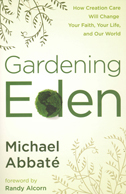 Gardening Eden: How Creation Care Will Change Your Faith, Your Life, and Our World
by Mike Abbate
Foreword by Randy Alcorn
A few weeks ago, I spoke at a conference of several thousand evangelical college students. Most were from Bible-believing churches like my own.
My message concerned the promise of a New Earth and the biblical principle of continuity. From Scripture, I pointed out that just as our old bodies will be destroyed, then made new in the resurrection, so the old earth will be destroyed, and then made into a New Earth. Next I cited Genesis 1 concerning why God put us on this planet. In fact, I’ll break right into the message here, quoting directly from the audio transcript, so you know exactly what I said (it’s important to the story):
….and God saw that it was good. And then God said, “Let us make man in our image, in our likeness; and let them rule over the fish of the sea, over the birds of the air, over the livestock, over all the earth.”
This was God’s purpose: that we rule the earth as His image-bearers to His glory; that we would care for the animals, and do the other things that we do in the development of culture.
So God created man in His own image; and God said to them, “Be fruitful and increase in number (not just the two of you; it’s going to be a world full of people). Fill the earth and subdue it.”
This word “subdue” is not a negative word. It doesn’t mean we shouldn’t be concerned for the environment. And by the way, of all people, as stewards, don’t you think we ought to have reasonable concern for our environment and try to take care of it?
I hadn’t planned to ask that question, but I did. Suddenly somebody applauded. Now, at conferences, if you ask a question to a crowd and there’s widespread affirmative agreement, often enthusiastic applause erupts. If there’s moderate agreement, there’s moderate applause. But even if relatively few agree, there’s an unspoken etiquette whereby some give a token applause, perhaps to rescue the speaker, and especially the lone clapper! But that day something remarkable happened. Nobody else clapped! The solitary clapper suddenly stopped, as if to say “Oops…never mind.” (Probably with the feeling you have when you realize in a big crowd of people you’re the only one laughing.)
I joked about the awkward moment, saying, “Wow! Someone started to applaud!” I was alluding to the fact that it was surprising that anyone would applaud a pro-environment statement at a conservative evangelical gathering (by the way, I am thoroughly evangelical and often conservative).
Now, trust me, it didn’t hurt my feelings that no one else applauded. Those attending this conference were very warm and responsive to my messages. No problem there.
But here’s my point: these people were serious Christians attending a Christ-exalting Bible-believing and Bible-teaching conference. Yet even the peer pressure exerted by that one individual clapping failed to elicit applause from so much as one other person. Why?
I think the answer is that the great majority of those present were not only theologically conservative, but socially and politically conservative. And concern for the environment is generally regarded as part of the liberal agenda. Hence, it seems contrary to us. And what sounds socially liberal sounds theologically liberal.
I’m politically conservative on issues such as abortion, in which lives are at stake, I am also concerned about the welfare of the environment God has entrusted to our care (in which, by the way, human lives are at stake).
Even if concern for the environment makes us “sound liberal,” we should be willing to express it because God says we are the caretakers of His creation. That is a biblical job description, a divine calling from the beginning. It shouldn’t matter whether caring for the poor or caring for the environment is considered conservative or liberal. Who cares? We should seek to be biblical and Christ-centered, loving God and our neighbor, and not worrying about labels and who else does or doesn’t agree with us on a given issue.
I trust there were many young people in that audience concerned about caring for the environment. Many of them might have joined the applause had someone made the comment on their college campus. But I believe their conservative evangelical conditioning did not allow them freedom. Even though I made my comment about the environment based on Scripture, it did not seem safe or appropriate to join the applause. Had I spoken in defense of the unborn, which I have on many occasions, in that same group if one person had applauded I guarantee others would have followed (unlike the deafening silence you’d hear on most secular college campuses).
Here’s the truth: care for the environment is not something that can be comfortably applauded in many Bible-believing church contexts.
I believe this needs to change. We need to be part of cultivating a new biblical peer pressure that is pro-creation. Gardening Eden can be part of that change.
For too long, evangelical Christians have neglected our God-given calling to care for the planet entrusted to us. One reason may be that our eschatology indicates the earth is headed for ruin anyway, so there’s no point in trying to rearrange the furniture on the Titanic. Well, I too believe that the present earth will come to an end, as graphically described in 2 Peter 3. But God made this earth, and He promises us a New Earth.
It makes no sense to say that because the earth will be destroyed, therefore we shouldn’t take good care of it! Do we think that because our bodies will be destroyed we shouldn’t take good care of them? (What would you say to your teenager if you warned him not to smoke, and he replied, “But it doesn’t matter, because the Bible says we’re going to die anyway”?)
God entrusts us with the earth as He entrusts us with our bodies, and He intends for us to take care of both. If you are conservative, then doesn’t it make sense to try to conserve your own health, your family’s health, and the health of the world we inhabit? (That “conservation” became a liberal term instead of a conservative one is counterintuitive.)
Perhaps because many of those concerned for the environment scorn the Bible and Christian beliefs, we have ignored our stewardship job description, as if it were somehow incompatible with the gospel. But it was God, not an environmental extremist, who delegated to us the responsibility of creation care. It was God, not an animal rights activist, who entrusted animals to us. Just as John 3:16 is inspired by God, so is Proverbs 12:10: “A righteous man cares for the needs of his animal.”
I have pointed out to people the inconsistency of their outrage that baby seals are being cruelly clubbed to death, while they defend the fact that baby human beings are being cruelly ripped apart in their mothers’ wombs. We should oppose cruelty to baby animals, and we should oppose even more cruelty to baby humans.
I stand with my friends, believers and unbelievers, who are concerned for the poor and the environment, even though we sometimes disagree on the best policies related to helping both. God’s Word makes clear His passion for the poor and His appointment of us as the caretakers of the earth. If I am a Bible-believing Christian, then these matters simply must concern me.
True, we cannot return this world to Eden. Yes, we should be looking forward to the New Earth, which God alone can make. (We humans have proven miserable failures when it comes to utopia-building.) Absolutely, human beings are more important than snail darters and spotted owls.
But we should still be caring for this Earth under the curse. While it groans awaiting redemption, as Romans 8 says, we need to be all the more careful to steward it with wisdom. We do this not because we owe our existence to Mother Earth; rather, we owe our lives to our Father God, and we owe it to Him to care for His Earth.
You do not have to like or agree with Ralph Nader or Al Gore in order to care about God’s creation. You can disagree, as scientists do, on the subject of the causes and effects of global warming. But Christians have no business dismissing everyone who cares about this planet as “environmental wackos” or “eco-Nazis,” cranks and chicken littles. Yes, of course there are extremists. (Hey, I live in Oregon, I know those extremists; but I still want Oregon to remain green!) Remember, there are “Christian wackos” too, but most of us do not appreciate being dismissed by that label. Don’t throw out the baby of responsible Earth-care with the bathwater of anti-enterprise gloom.
In Gardening Eden, my friend Mike Abbaté has done a wonderful job drawing attention to our calling to care for the Earth. His book is well-researched and readable, engaging and valuable. There is a directness, focus and passion to Gardening Eden, coupled with a rational and thoughtful consideration of others.
This book in your hands is not written by someone on the radical fringe, out of touch with the modern world. From the day Mike first met with me to share his vision for this book, I could see that he is smart and savvy, wise and articulate. Mike is a skilled professional, an architect and a city planner, an accomplished expert in his field. He is also a Bible believer and a committed follower of Jesus. Good for him that he takes so seriously the sacred task of stewarding God’s earth. I am delighted to stand with him.
As you read Mike’s book, keep in mind God’s Word. “The earth is the Lord’s and everything in it, the world, and all who live in it” (Psalm 24:1). This is not our place to trash. It’s God’s place to treasure. And to care for the world, is to care for its people.
Scripture says, “The Lord rejoices in all He has made” (Psalm 104:31). If He rejoices in it, so should we. When you rejoice in something, you go out of your way to preserve it.
Proverbs 21:29 says, “In the house of the wise are stores of choice food and oil, but a foolish man devours all he has.” Foolish people consume, wise people preserve, understanding that even if we die tomorrow, we should leave something behind for our children and our children’s children, and the generations that may follow. The Earth is not disposable. Nor are its resources inexhaustible.
Creation care makes good sense even if it were not explicitly stated in our job description. But read Genesis 1 and 2, and you will see that it clearly is.
If I told you I loved my children but allowed open gas lines in the house, removed the smoke detectors, and let broken windows go unfixed, you would have reason to question my parenting. Why? Because if a parent loves his children he’ll do his best to provide them a safe home.
God never revoked His plan to entrust the earth’s care to us. Romans 8 makes clear that the whole creation fell on our coattails, and, in our resurrection, will rise on our coattails—all the more reason that we should care for it.
Now, my discretionary stewardship decisions may look quite different than yours. You don’t have to do it my way; I don’t have to do it yours. But together as Christ-centered, Bible-believing, people-loving Christians we should agree also to be creation-loving. We shouldn’t have to follow secular culture in reasonable creation care, we should lead the way. And when people ask why we care about the planet, we should be ready to tell them we love the world because we love its Creator and Redeemer.
Mike doesn’t leave us on the theoretical level, but offers specific suggestions for creation care, right down to alternatives in growing and buying food.
Mike Abbaté is not using this book to make extreme claims or pick a fight or take political sides. This is not a political book that stereotypes or berates people or assumes the worst of them. If you find some things in the book you disagree with, fine. You don’t have to wear a Tree Hugger t-shirt (I don’t). We can disagree about the ultimate causes and significance of global warming, and which government policies will and will not help care for the environment.
Can’t we just agree to be good stewards of God’s Earth?
Gardening Eden contains good theology, worldview, science, and practical application. This book is fair and balanced, demonstrating an unapologetic love for God’s creation, something conservatives and liberals alike should share. It is a welcome and much-needed resource, whose time has come. I pray it will open the minds and hearts of many to the privileges and responsibilities of stewarding God’s world.
Now, let me finish my story. After speaking at the evangelical youth conference that day, I stayed and spoke with many great students who were wonderfully responsive. Afterward, as my wife Nanci and I headed to lunch, I smiled and said to her, “Wasn’t that something when that poor person applauded, and nobody else joined in?”
Nanci, eyes big, replied, “That poor person who applauded was me!”
Well, Nanci, I know you will applaud Mike Abbate’s book. And I hope you, the reader, will join in applauding the notion that we should be thoughtful caretakers of God’s creation. Not in spite of the fact that we believe the Bible and trust Jesus, but precisely because we do.
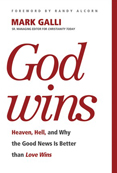 God Wins
by Mark Galli
As a journalist educated at UC Santa Cruz, Fuller Seminary, and UC Davis, Mark Galli is not someone whose résumé screams “intolerant fundamentalist.” Whether it’s meant as a compliment or otherwise, most who know Mark would call him open minded. He doesn’t rush to judgment or hastily draw lines in the sand.
Mark is a big-tent evangelical, but his penetrating critique of Rob Bell’s Love Wins is a reminder that even a big tent can be only so big before terms such as Bible believing and evangelical, in the historic sense, begin to lose their meaning.
Evangelical churches, both Calvinist and Arminian—while holding divergent positions on baptism, church government, and eschatology—have consistently held the common belief that everyone will go to one of two eternal destinations: heaven or hell.
As a historian and a former editor of Christian History magazine, Mark Galli is acutely aware of something many modern authors appear not to grasp: God hasn’t given this generation—so accustomed to opinion polls that want to know what we think—the luxury of remaking theology on the fly and redefining the gospel.
Mark graciously and skillfully shows how the Love Wins version of the Good News is actually bad news. Our culture needs us not to reinforce its soft, malleable, and fleeting worldview but to offer a God-revealed, redemptive alternative. Mark’s trinitarian emphasis roots the gospel not in personal experience but in God’s own nature, which is what ultimately led to his creation and redemptive plan. That’s why this book is much more than a critique, and something of a manifesto.
C. S. Lewis warned against chronological snobbery—the assumption that recent viewpoints are better than ancient ones. Love Wins minimizes the doctrines of penal sacrifice and substitutionary atonement, ascribing them to “primitive cultures.” In contrast, Galli embraces these doctrines and quotes unapologetically (and in context) Jesus and Paul, as well as Luther, Edwards, and Spurgeon. The gospel he affirms is timely precisely because it is timeless.
Mark’s book is built on biblical and historical rock, not cultural sand. That’s exactly the needed foundation for a response to Love Wins, an attractive book heavy on feelings but light on biblical and historical reasoning.
Love Wins asks hundreds of questions but offers few answers. What God Wins says about asking questions is worth the price of the book: “There are questions, and then there are questions.” Mark Galli examines the justice questions of Job and Habakkuk, contrasting them with the self-absorbed questions of Pilate. He quotes God, who says to Job, “Who is this that questions my wisdom with such ignorant words? Brace yourself like a man, because I have some questions for you, and you must answer them” (Job 38:2-3).
Though Christ’s words about hell are clear, emphatic, and repeated, our temptation is to think he didn’t mean what he said. But isn’t the most obvious conclusion that he really did? And that the doctrine of hell isn’t a ballot measure, and God doesn’t give us a vote? Hell is dreadful, but it is not evil—it’s a place where evil gets punished. Something can be profoundly disturbing yet still be moral. Hell is moral because a good God must punish evil.
C. S. Lewis said of hell, “There is no doctrine which I would more willingly remove from Christianity than this, if it lay in my power. But it has the full support of Scripture and, specially, of our Lord’s own words; it has always been held by Christendom; and it has the support of reason.” Dorothy Sayers, another broad-minded Christian, claimed, “We cannot repudiate Hell without altogether repudiating Christ.”
If we are free to reinterpret God’s Word at will, then it is not authoritative. Christ is not authoritative. I am authoritative. My faith becomes merely a collection of fleeting opinions, always subject to revision. And that is something quite different from historic, biblically grounded Christian faith.
Love Wins argues, “God gets what he wants.” Yes, but what he wants is not limited to everyone’s salvation. It also includes justice. The God revealed in Scripture is not a love-only, single-attribute God. Vital as his love is, the seraphim in his presence do not cry out day and night, “Love, love, love is the Lord God Almighty.”
Love—as moderns narrowly define it—doesn’t win. Rather, as Mark’s title so aptly puts it, God Wins. And not just any God, but the true God. The Father who is both loving and righteous, the Son who is full of both grace and truth, the merciful Spirit who has the word Holy in his very name. God’s attributes aren’t a menu from which we may choose only what we wish—he is allthat he is, all the time.
The issues underlying both Love Wins and God Wins are, in the end, far bigger than hell. If we can still claim to be Bible believers while radically reinterpreting Christ’s words about hell, stripping them of their straightforward meaning, why should it end there? What about Christ’s virgin birth? His physical resurrection? His deity? What about moral issues? Why not reject everything we can’t figure out? And what would someone have to reject, short of the very existence of God or his Son, in order to no longer be an evangelical Christian?
If the orthodox views on salvation and damnation are up for grabs, then surely virtually everything in the Apostles’ Creed is also. Evangelicalism may survive attacks from the outside, but it faces the impending sinkhole of inner erosion. That’s why I believe God Wins offers help not just for the issues of hell and universalism but also for many other issues the church is already facing, or inevitably will.
This all has profound implications about what it means to speak on behalf of God. Our job is not to be God’s public relations manager or make him popular. The Almighty doesn’t need us to give him a facelift and airbrush his image. “But surely it isn’t bad to try to make God look good, is it?” The question is, look good on whose terms? God has his own terms. Our task is not to help people see God favorably but to see him accurately. God has the power to touch hearts and draw people to his love and grace while they fully affirm his holiness and justice. It’s not either/or but both/and.
God has appointed us to faithfully deliver his message, not to compose and edit it. He has already written the message—it’s called the Bible. Who are we to spin it and tame it, or presume to be more loving than Jesus, who with outrageous love took upon himself the horrific penalty for our sin?
God’s position is already taken; we need not apply. We do not own the Christian faith. It isn’t ours to revise. God’s Word wasn’t entrusted to us so we could give it away piecemeal, leaving the next generation with the leftovers. If we go on decade after decade parceling out fragments of the faith, what will be left? When we abandon truths Christians once died for, will we no longer have truths worth living for?
Mark Galli clearly grasps the miracle that God’s amazing grace delivers us from the hell we deserve. God can and will bridge the gap between himself and people, not through our doctrinal revisionism but through his sovereign grace.
I love the fact that God Wins doesn’t discourage honest questions but calls on us to go to God’s Word for honest answers. Mark encourages us to recognize the mysteries of God and respectfully bow our knees to his divine authority.
I pray you’ll read this book with the knowledge that our churches are at a doctrinal and leadership crossroads, and much is at stake. If our sins aren’t big enough to warrant eternal punishment, then perhaps the grace God showed us on the cross isn’t big enough to warrant eternal praise. (God forbid that we should beleive this.)
We are sometimes tempted to shrink God so he fits inside the borders of our minds. But those are small borders, and he is a big God. There is great comfort in knowing a God who loves me but doesn’t need my counsel. The best part about God Wins, from my perspective, is that as I read it, God became greater and I became less.
Randy Alcorn
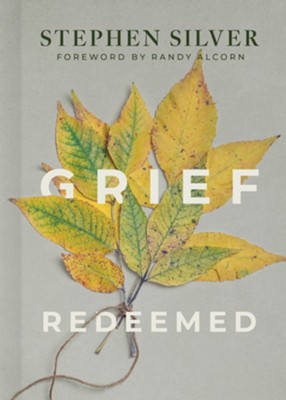 Grief Redeemed
by Stephen Silver
Just three months before I said goodbye—for now—to my wife, Nanci, Steve Silver’s wife, Sandy, went to be with Jesus. One day I didn’t know Steve. The next, after a few hours talking together, I knew I’d found a good friend.
Twice, he interviewed me about my grief journey and my final years with Nanci, and a deep bond was formed. In those interviews Steve and I talked together about our dear wives, the present Heaven they enjoy now, and the future Heaven that God will bring down to the New Earth, after the resurrection of all God’s people.
Sandy and Nanci shared much in common, including their roles as our partners, soulmates, and best friends. Steve and I now share the common pilgrimage of grief, walking a path that, though full of learning and enrichment, is one we would gladly exchange to have our wives with us again. And yet…not really, because we both recognize God’s sovereignty and love, and His perfect plan, and the fact that our wives are now happier than they have ever been.
Nanci experienced firsthand the closeness of Jesus in her suffering. She wrote in her journal, “My relationship with God has deepened more than I ever could have imagined during this cancer. I have tasted and seen that the Lord is good! [Psalm 34:8] I trust and cling to Him more. I worship Him more. I love Him more! The Bible speaks to me more. The Holy Spirit’s ministry feels more real to me.”
I often picture Nanci’s entry into Jesus’ presence nearly a year ago. I imagine that while Jesus was both Sandy’s and Nanci’s center of attention, they also loved seeing relatives who had died—in Nanci’s case, her mother and father and my parents, and our grandchild she’d not yet met, taken into Heaven before birth. It makes me smile to think of Nanci and Sandy meeting each other in Heaven and learning that their husbands are now friends.
As I told Steve, one of the truths I so love is that while Sandy and Nanci went ahead of us to the present pre-resurrection Heaven, which is “better by far” than this earth under the curse, one day we will all be raised to life on the New Earth. There, John says of our Lord, “He will wipe every tear from their eyes. There will be no more death or mourning or crying or pain, for the old order of things has passed away. He who was seated on the throne said, ‘I am making everything new!’ Then he said, ‘Write this down, for these words are trustworthy and true’” (Revelation 21:4-5).
On that day, Sandy and Nanci and Steve and I—and all of God’s risen people—will behold “the river of the water of life, as clear as crystal, flowing from the throne of God and of the Lamb down the middle of the great street of the city. On each side of the river stood the tree of life, bearing twelve crops of fruit, yielding its fruit every month. And the leaves of the tree are for the healing of the nations. No longer will there be any curse. The throne of God and of the Lamb will be in the city, and his servants will serve him. They will see his face…” (Revelation 22:1-4).
Can you imagine what it will be like for us all together—people of every tribe, nation, and language—to see at last the place that the Carpenter from Nazareth has prepared for us? Wow!
In this deeply personal and thoughtful book, Grief Redeemed, Steve Silver pours out his heart and tenderly examines aspects of his grief. He speaks of Sandy as his silent partner. He has “the memories of how Sandy would weigh in on decisions, encourage me in plans, guide me in right actions, and be an advocate for everything done for the Lord.” I so relate. Nanci is my silent partner every day.
And yet in another way, she is not silent, nor is Sandy. Hebrews 11:4 says, “And by faith Abel still speaks, even though he is dead.” Sandy and Nanci still speak to everyone who knew them here. And they speak to those they’ve been reunited with and have met for the first time. And they will forever speak, and one day we will hear not just memories of their voices, but their real present tense voices, more delightful than ever.
I have written that grief has become my friend. When I saw Steve sharing the same, and also that grief was God’s anvil to work on him, I recognized a common insight from the Holy Spirit. Neither of us asked grief to come into our lives because grief only comes with loss. But loss will come, and good grief can help us move forward through our losses, becoming more like Jesus in the process…if we let it.
“For our light and momentary troubles are achieving for us an eternal glory that far outweighs them all” (2 Corinthians 4:17). Our deep pain in having to face this fallen world without our wives isn’t just suffering for us to get beyond; it is suffering that is purposeful, achieving what’s of eternal value. Because we know that, the next verse says, “So we fix our eyes not on what is seen, but on what is unseen. For what is seen is temporary, but what is unseen is eternal” (2 Corinthians 4:18).
If your loved one has already died, I’m sure Steve’s book will help you. If you or your spouse or a family member or close friend are dying, I hope this book will lead you to conversations about Jesus and the afterlife, and the need to prepare for it. I am so grateful that Nanci and I talked about Heaven openly and often over decades, and I would encourage you to do the same.
Believing her death was coming soon, Nanci asked me if I would bring together our family of eleven—our two daughters and their husbands, and our five grandchildren. She wanted to speak into all our lives, and we gathered two days later. She spoke to her grandchildren especially, with tenderness and humor, and encouraged them never to resent God for taking her, because God always knows best and works even hard things for our eternal good. When she could speak no longer because of exhaustion, I read to the family from her journals. All of us were deeply touched. There were many tears, but also laughter, and it was Nanci’s laughter that gave permission and blessing to ours.
One of our 17-year-old grandsons said, “Grams, if you can trust God like this when facing such hard things, I know I can trust him too in the tough times I face.” Another said, “I will never forget what you said to us today.” We placed our hands on her and prayed over my wife, and our daughters’ mother, and our grandsons’ Gramma. It was a sacred time in which we caught glimpses of a far better world that she already had one foot in. What we experienced that day made me realize that none of us needs to wait until we think we’re dying to gather and talk to our family as Nanci did. I’ve since encouraged others to consider doing this sooner rather than later.
Steve says that he didn’t think much about Heaven before Sandy went there. That changed everything for him, and he experienced a transformed perspective. I’d thought a great deal about Heaven before Nanci died, having written seven books about it. But while what I learned during those hundreds (come to think of it, thousands) of hours spent on research and writing was a great encouragement, it didn’t make saying goodbye to Nanci easy. That process, however, bolstered my wholehearted belief that Nanci’s death was not the end of our relationship, only a temporary interruption. The great reunion awaits us, and I anticipate it and delight in imagining it with everything in me.
Jesus kindly delivered Nanci and Sandy from their suffering. To know my sweetheart will never suffer another moment for all eternity brings tears of joy as I write these words.
When Nanci left for Heaven, part of me left with her. Other than Jesus, the greatest treasure I’ve ever had on Earth was Nanci. And Jesus said, “Where your treasure is, there your heart will be also.” Because Jesus is in Heaven, and He is my greatest treasure, my heart has long been there. But with Nanci there, as much as I love all my family and friends, my heart and mind are often in that other place. I’m encouraged by the command, “Set your minds on things that are above” (Colossians 3:2).
I’m grateful God still has a place for me as long as I’m here, just as Steve is finding the place God has for him. And, like Steve, I sometimes want to do something that I would’ve done when Nanci was still here.
One day somebody texted a photo of their dog, and I immediately thought, I need to forward this to Nanci. Suddenly, the truth dawned on me: Nanci had been with Jesus 10 months, and my instinct was still to send her a dog photo!
As Steve misses Sandy’s daily presence, I find myself missing the thousands of little moments Nanci touched my life. Most of all I miss her laugh, which was frequent, loud, and contagious. She infused our home with happiness. I am still happy, but in Nanci’s absence I find I must be more deliberate in noting all the reasons in Jesus that make me happy.
The time came, as it has for many others, when Nanci and I changed our prayers from “Lord, please heal Nanci: to “Lord, if You are not going to heal Nanci, please take her home soon.”
With tears of joy and a love radiating from her eyes that I still see, she said to me, “Randy, thank you for my life!” Eyes, full of tears, I said, “Nanci, thank you for my life!” Later, in her final days here in our earthly home, she said to me, “Randy, please take me Home.” I said, “If I could I would take you Home right now and I would never come back to this world the way it is.”
I resonate when Steve says home for him was wherever Sandy was. It didn’t matter where he was as long as she was there. My house is less my home without Nanci, but Heaven is more my home.
Steve realizes that his true home is where Jesus is—and isn’t it great that Jesus and Sandy are in the same home? Likewise, Nanci is with Jesus forever, and therefore, when the time comes fro me to be with Jesus, it will mean being with Nanci. The two best friends I’ve ever had.
Nanci’s final journal entry was, “I told the doctor today that I don’t want to fight the cancer in order to just give me more time. I am going off chemo. I am so relieved and honestly excited! I will see Jesus pretty soon!!!” Exactly one month later, she did.
I often think of Nanci’s reassurance to herself and to me: “God’s got this! God’s got me!” She wrote, “I will be ready to die when my time comes because my Shepherd will give me His joy, peace, and readiness. It will not be me working up enough faith and trust; my God will fight the battle for me! It will be His perfect ministering Spirit who will carry me peacefully—jubilantly—into God’s arms.”
I was a witness to the “peacefully” part as I watched her fall asleep, and then suddenly, I realized she’d stopped breathing, and, tears running down my face, I kissed her goodbye. Meanwhile, God, the angels, and likely some of Heaven’s inhabitants witnessed the “jubilantly” as they opened wide their arms and kissed her hello. I have no doubt Nanci and Sandy both heard those words that should stir our hearts: “Well done, my good and faithful servant. Enter into your Master’s happiness.”
Sandy and Nanci were recipients of God’s promise: “you will receive a rich welcome into the eternal kingdom of our Lord and Savior Jesus Christ” (2 Peter 1:11). May each of us experience the same.
I pray each reader of this book will be drawn to Jesus, the Redeemer of Steve and Sandy, and Randy and Nanci, and all who place their trust in Him. He is the One who makes Heaven such a wonderful place, because He is such a wonderful person.
 Holiness: The Heart God Purifies, with Small Group Study Guide
by Nancy Leigh DeMoss
Foreword by Randy Alcorn
Several years ago, my daughter Karina—whose judgment I deeply respect—read Nancy Leigh DeMoss’s Lies Young Women Believe: And the Truth That Sets Them Freee and recommended it to me as a great book. Since then I’ve come to know Nancy as a precious sister. When I’ve read her books, and spent time with her doing her radio program or talking on the phone, I’ve been drawn to Jesus.
Readers can rest assured that Holiness: The Heart God Purifies comes out of a life that has firsthand experience with the subject matter. The holiness I’ve seen in Nancy doesn’t scream “Look at me—I want you to be impressed with my holiness.” It’s not the check-off-the-boxes legalism perfected by the Pharisees and paraded by a thousand Christian groups since. It flows from a heart humbly submitted to Christ’s lordship. Nancy’s holiness is saturated with grace.
“Be holy for I am holy.” God is the reason we should be holy. But he’s also the empowerment for our holiness. Many of us are convinced we should be more holy, but we’ve gone about it wrong. To be holy in our strength, and for our glory, is to be distinctly unholy. To be holy in Christ’s strength and for his glory...that’s our calling, and our joy.
Like Jesus, this book is full of grace and truth—challenging yet winsome, convicting yet inviting. True holiness isn’t cold and deadening—it’s warm and inviting. It’s irresistible. Those who think otherwise have never seen it, but only its caricatures. In this book Nancy strips “holiness” of its baggage, so we see it as it is. And, contrary to popular belief, it’s something beautiful.
Yes, there is the carry-your-cross demand. But there’s also Christ’s assurance, “Come to me, all you who are weary and burdened, and I will give you rest....For my yoke is easy and my burden is light” (Matthew 11:29-30).
Holiness is the only path to happiness. Every time I’ve been unholy it has made me unhappy. Every time I’ve been holy it has made me happy. Holiness sometimes hurts in the short run, but an hour or day or month or year or lifetime from now, holiness always brings happiness. Jesus promised it would: “Happy are the pure in heart, for they shall see God.”
Nancy says, “No amount of striving or self-effort can make us holy. Only Christ can do that.” Gladly, I want to shout, “That’s true!”
She says, “Somehow, the evangelical world has managed to redefine sin; we have come to view it as normal acceptable behavior—something perhaps to be tamed or controlled, but not to be eradicated and put to death. We have sunk to such lows that we can not only sin thoughtlessly, but astonishingly, we can even laugh at sin and be entertained by it.”
Sadly, this time, I say, “That’s true.”
Each day the God in whose presence the seraphim cry “Holy, Holy, Holy,” examines every secret corner of our lives. He’s the Audience of One. What really matters is whether he is pleased with our lives.
May we humbly acknowledge that when it comes to holiness—with all its sacrifices and rewards and pleasures—apart from Christ we can do nothing. But by his grace and empowerment, we really can live so that we may one day hear him say those amazing, thrilling words: “Well done, my good and faithful servant!”
The moment we hear those words, from the mouth of our Lion and Lamb, we’ll know that in comparison, nothing else matters.
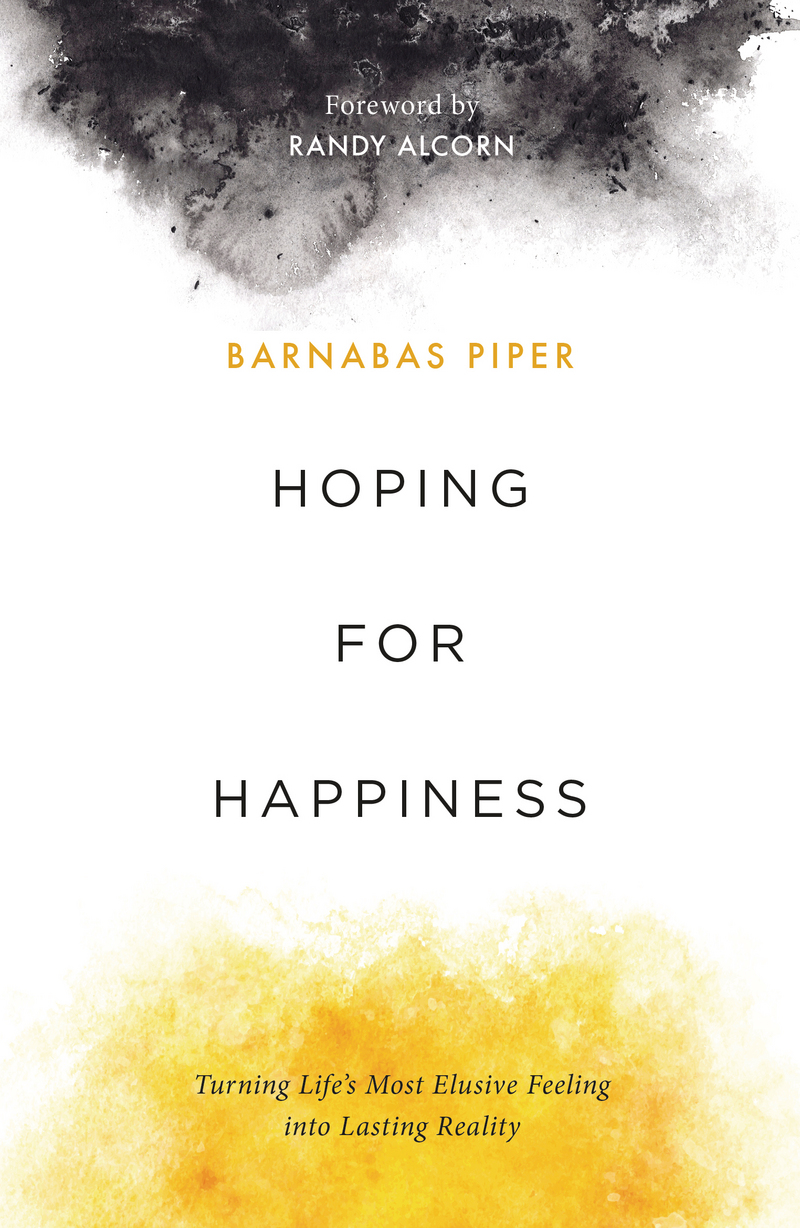 Hoping for Happiness
by Barnabas Piper
Spoiler alert: I loved Hoping for Happiness.
Barnabas Piper hooked me when he said, “One of the main reasons I wrote this book is because I was tired of wrestling with guilt over having fun and enjoying myself. It seemed strange that God would give so many wonderful gifts only for me to feel guilty enjoying them.”
I grew up in a home with no knowledge of Jesus or the good news. I was often unhappy, spending night after night listening to music that promised happiness but failed to deliver it. Gazing at the night sky through my telescope, I longed for a connection to the wonders of the universe but couldn’t find one. When I was in high school, Jesus drew me to himself. Everyone—and first of all my mom—noticed the change. The most obvious difference? I became much happier.
I loved my first-ever church, but it struck me as strange when the pastor said, “God doesn’t want you happy; he wants you holy.” Well, I was holier than I’d ever been, but I was much happier too. Was something wrong with me?
That wonderful pastor often cited Oswald Chambers’s great book My Utmost for His Highest, which I eagerly read. But at the time I didn’t know enough to disagree when Chambers said, “Joy should not be confused with happiness. In fact, it is an insult to Jesus Christ to use the word happiness in connection with Him.”
I certainly didn’t want to insult Jesus by saying he was happy or he made me happy! And I couldn’t for the life of me figure out the difference between joy and happiness. (In fact, they are synonyms for everyone except Christians who’ve been taught otherwise.
After a steady diet of such teaching, I became wary of happiness. Had I seen this book, Hoping for Happiness, back then, I’d have thought, “We shouldn’t hope for what God doesn’t want us to have.” I’d never have believed that I’d one day write a book titled Does God Want us to Be Happy? And I would have assumed the answer must be a resounding no!
Like Barnabas, I felt guilty for being happy. The message seemed to be “You could impress God if you chose a life of miserable holiness.” It took me decades to realize that this wasn’t merely a misguided and thoroughly unbiblical idea; it was a lie from the pit of hell. It undermined the “good news of happiness” (Isaiah 52:7, ESV, NASB).
Barnabas writes, “Everyone, whether they believe in God or not, has a deep internal yearning for eternal significance and happiness.” That’s why it’s counterintuitive and counterproductive to pit happiness and holiness against each other. Jesus himself, the holiest human there’s ever been, was the life and soul of the parties he got invited to. (His first miracle was to rescue a wedding celebration that ran out of wine.) Children loved him. Had he been stern and unhappy, they wouldn’t have.
Instead of “don’t seek happiness”—a command impossible to obey anyway—why not “seek your primary happiness in Jesus, and fully enjoy the derivative happiness in his countless gift, including family, friends, food, work and play”?
We love and serve one who reveals himself as a “happy God” (“blessed,” 1 Timothy 1:11; 6:15). We are to put our hope in “God, who richly provides us with everything to enjoy” (1 Timothy 6:17).
Barnabas calls on us to see God as “a generous Father, who showers you with good things day by day and invites you to enjoy them freely, daily, for your pleasure.”
The years I devoted to researching and writing various books on happiness were life-changing. I discovered Scripture speaks of exactly what I’d experienced: not a flimsy superficial optimism but a happiness that’s biblically grounded in the rock of Christ’s blood-bought promises.
Truth is, the good news should leak into every aspect of our lives, even if we’re not consciously talking about God or witnessing to someone. The “good news of happiness” should permeate our lives with, well, happiness. True holiness is happy-making, and all ultimate happiness is holy-making.
Barnabas couldn’t be more right when he says, “A laughing Christian who relishes good things is a compelling, magnetic Christian—the kind who draws people to truth.”
This echoes what J. C. Ryle wrote 150 years ago:
“It is a positive misfortune to Christianity when a Christian cannot smile. A merry heart, and a readiness to take part in all innocent mirth, are gifts of inestimable value. They go far to soften prejudices, to take stumbling blocks out of the way, and to make way for Christ and the gospel.”
There is no greater draw to the gospel than happy Christians who are full of grace and truth, quick to laugh and quick to weep for and comfort those who suffer.
My wife, Nanci, and I have been married for 43 years. In the last three, as we have faced her cancer together, we have found a deeper happiness in God and each other than ever before. We have known firsthand the “hopeful, grounded realism” That Barnabas writes of. Trusting in Jesus has brought us great happiness in him, even amid suffering and the threat of death.
In this delightful book, you’ll see that Barnabas loves Jesus, family, sports, food, fun, God’s creation, and life in general. So do I. We don’t pass our peaks in this life. We don’t even begin to reach them. A new earth awaits us. I envision Christ’s laugh will be the loudest and longest at all those great feast ahead of us. But why wait? Why not front-load our eternal happiness into our here-and-now and give ourselves and others a taste of heaven?
Hoping for Happiness says, “Hang your happiness on the right hooks, hang your hopes on God’s promises, fear him, and obey his commands—and in this you’ll find happiness, now and forever.”
I know how good this book is. I’ve read it. Now it’s your turn!
Hope for the Brokenhearted: God's Voice of Comfort in the Midst of Grief and Loss
by John Terveen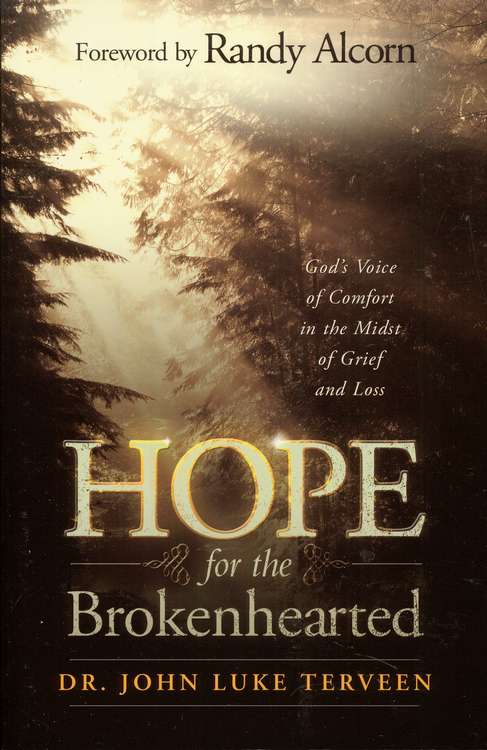
I remember like it was yesterday hearing the stunning news of the death of fourteen-year-old Rachel Terveen.
Rachel’s family was part of our church. Her brother Matt was the same age as our daughter Angie. The church and community mourned. Though I didn’t know her personally, Rachel has come to my mind often over the years. When I wrote my book Heaven, I included her in the dedication.
Rachel was an athlete, young and vibrant…if any death was unthinkable, hers was. Nanci and I looked at our own daughters, and realized no one is immune to death. In Psalm 90:12, Moses prayed, “Teach us to number our days aright, that we may gain a heart of wisdom.” John Terveen, Rachel’s father, has written a book that offers such wisdom.
Hope for the Brokenhearted is honest. It comes from the heart, where at times pain and faith and doubt have slugged it out inside the author. Grief is a journey, often confusing and sometimes terribly lonely. This book isn’t full of easy answers—which is good, since there are none. But it is full of hope and Christ-centered perspective.
A former pastor, Dr. Terveen is a Greek professor at Multnomah Biblical Seminary, a school I had the privilege of graduating from thirty years ago. His book is steeped in Scripture. It therefore has a power most books don’t. Those grieving need to hear from God. He promises His Word, not ours, will not return to Him empty, without accomplishing the purpose for which He sent it (Isaiah 55:11).
Our churches and communities, our nation and our world, are filled with grieving people—numb, broken, bitter or simply exhausted. They need to hear from someone who has been where they are. John Terveen has been there.
Who of us has not been touched by death? A dear friend of mine died at age 19 in a terrible farm accident. My uncle was murdered. My mother was suddenly taken by cancer 24 years ago. Eleven years later, to the day, I was holding the hand of my closest friend when he died at age 38. My wife and daughters and brother and I were with my father when he died eight years ago. My wife’s dear mother died, and her father is failing this moment. Three families we know have lost one of their beloved parents in the last four weeks. Two days ago a pastor friend conducted the memorial service for his infant granddaughter. On and on it goes. Your list is as long as mine.
But here is the good news, and it is breathtaking: one day God “will swallow up death forever” (Isaiah 25:7). All that is wrong will be made right. “No longer will there be any curse” (Revelation 22:3).
Jesus said, “Blessed are you who weep now, for you will laugh. . . . Rejoice in that day and leap for joy, because great is your reward in heaven” (Luke 6:21-23). This is the promise of God: His children who weep now at all their losses, will laugh in Heaven.
I began by saying I didn’t know Rachel Terveen personally. That’s true, but one day I will meet her. I’ll get to hear her laugh. I’ll watch the smiles of her father and mother and her Lord Jesus, as they look at her. As resurrected people, we’ll walk together on God’s New Earth.
Our Lord promises, “He will wipe away every tear from their eyes; and there will no longer be any death; there will no longer be any mourning, or crying, or pain” (Revelation 21:4).
That day may seem distant, but it is coming. Bank on it. Until it arrives, I pray this book will offer you help and assistance on the journey.
 Passport Through Darkness: A True Story of Danger and Second Chances
by Kimberly L. Smith
Foreword by Randy Alcorn
I first met Kimberly Smith when she visited our Eternal Perspective Ministries office. EPM had been supporting Make Way Partners and Kimberly came to share more about their outreach to the orphans in Darfur, Sudan.
I was in the process of writing my book, If God is Good, so I interviewed Kimberly about the suffering she had witnessed and the light God was shining in the darkness. Later I met her husband Milton and thanked him for releasing his precious wife for the cause of Christ. At the time I wasn’t aware of the personal trauma she endured while in Darfur.
It’s astounding that Kimberly and Make Way Partners were able to establish an orphanage in southern Sudan, one of the poorest nations in the world, with one of the highest per capita rates of victims of human trafficking and enslavement. The challenges seemed insurmountable, and yet by God’s grace it happened. And now other orphanages are being built.
We’ve been privileged to continue our partnership with Kimberly in the ministry of Make Way Partners. I’m glad to see Passport Through Darkness, as this is a remarkable story that needs to be told.
While reading this book you may weep and ask “Why?” It’s not easy to think about traumatized and abused children. You may be tempted to stop reading. Kimberly’s poignant story of the dire situations she dealt with will stay with you for a long time. But facing the distressing realities can move you into caring for the widows and orphans so close to God’s heart. “Religion that God our Father accepts as pure and faultless is this: to look after the widows and orphans…” (James 1:27).
Kimberly shares her own journey honestly and from the heart. While serving these precious orphans, she suffered at the hands of evil men who didn’t care about her or the work she was doing. But God in his faithfulness has given her strength and help to work through her trauma as she continues to serve the extremely needy children of this world. I commend her for sacrificing her privacy by telling her story to be of greater service to God’s people.
I know Kimberly and Milton’s desire is that what you read in this book will be used of God to motivate you to action on behalf of vulnerable children around the world. In the process, as you walk with Kimberly, you may also find perspective, forgiveness and healing in your own life. May God use his servant’s story to His glory. Not only Kimberly’s, but yours and mine.
Randy Alcorn
Author of Heaven & If God is Good
 The Listener: What if you could hear what God hears
by Terri Blackstock
Foreword by Randy Alcorn
My friend Terri Blackstock has written a simple yet profound story with a vital message.
First, though, I want to say how I rejoice that The Listener’s royalties all go to a great cause, Samaritan’s Purse, an agency that gives people food, clothes, help, and the good news about Jesus Christ. You can read Terri’s heart by her choice to lay up her treasures in heaven, not on earth. She is living out the book’s vision by recognizing people’s deepest needs and reaching out to help them in the name of Jesus. May the rest of us do the same.
We are all made for a person and a place. Jesus is the person. Heaven is the place. As Christians our lives and our words should draw others to what they desperately need. As we see in The Listener, we must become more alert to the people around us, realizing the Jesus we have is the Jesus they need.
While reading this book, I thought about how God hears the heart cries of all people everywhere, every moment. Jesus went to the cross to deliver us from our suffering. His eternally scarred hands and feet proclaim how expensive and valuable His gift is. We must first come to grips with this, and only then will others see it through us.
Terri captures the fact that it isn’t just other people who are missing out on what we have to offer them. It’s we who are missing out on the joy of being used by God. We need to share Jesus as much as people need to hear about Him.
If your Christian life is boring, this book offers a cure. Disciples live on the edge, asking, “How can I serve you today, Lord? Who can I touch for you?” And at the end of the day they can pray, “Thanks for using me, Jesus.” They don’t think about the day’s sacrifices. They think about the sheer joy of being used by God to touch the lives of others—to meet their needs, love them and share the truth about Jesus through their actions and their words. When Jesus said “It’s more blessed to give than to receive,” he wasn’t kidding!
As we see in The Listener, every day people with great needs pass beneath our radar. We need to change our radar setting and learn to see those people and their needs. Neighbors, co-workers, parents we sit by at our kids’ games, the mail carrier, bus driver, grocery checker, pizza guy, UPS delivery person...they all need Jesus. They need to hear us say, “Taste and see that the Lord is good.” (I have a friend who regularly says to telemarketers, “I will listen to what you have to say, if when you’re done you’ll listen to something very important I’d like to tell you.” They almost always agree, and he shares the gospel. Even annoying interruptions can be divine appointments!)
I pray that through reading Terri’s book, many will be inspired to listen to the cries—even the silent ones—of people all around us who need to know Jesus. And may we learn to treasure the privilege that’s ours to tell people about the one we love, because he first loved us.
 The Slumber of Christianity: Awakening a Passion for Heaven on Earth
by Ted Dekker
Foreword by Randy Alcorn
Rise up from slumber. Set your mind and heart on an inheritance that will blow your mind. Feel your heart flutter and find a new passion for life here and now. This is the call from Ted Dekker, who writes with passion and insight on the search for happiness and heaven.
“Are you desperately longing for heaven?” It’s a question that begs answering. Peter says, “we are looking forward to the new heavens and new earth” (2 Peter 3:13). But, in fact, as Christians today are we? Are we actually looking forward to and longing for our eternal home?
Heaven plays a major role in my novels and nonfiction. Researching my book Heaven, I read 150 volumes on the subject, many long out-of-print. I’ve taught a seminary course “A Theology of Heaven.” I’ve received literally thousands of letters and emails about heaven. There’s a great deal I don’t know, but one thing I do know is what Christians think about heaven. And how seldom we think about it.
Sadly, Ted is right when he says “the church today has little passion for the coming life.”
What a contrast to the early Christians. Their pictures on the catacomb walls portrayed heaven with beautiful landscapes, children playing, people feasting at banquets. Believers throughout the ages saw heaven as a constant source of strength and perspective. It was their central reference point, the north star by which they navigated their lives. But today, heaven has fallen off our radar screens.
What God made us to desire is exactly what he promises: a resurrected life in resurrected bodies, in a resurrected community, with the resurrected Christ on a resurrected Earth. This is the eternal heaven that awaits us, and should daily capture our imaginations.
Ted’s right—we’re slumbering. We need to wake up and smell the New Earth. Taste the coming resurrection. The doctrines of resurrection and New Earth mean that this present world, though suffering under sin and curse, is bursting with clues and foretastes of the coming world.
The Carpenter from Nazareth is preparing a place for us. He knows how to build. He’s constructed entire worlds, billions of them. He’s going to strip the damaged paint off the old Earth, sand and refinish it, then present it magnificent and pristine. He says it will one day be our home...and His, for He will dwell there with His people, forever bringing heaven to earth (Revelation 21:3).
With the Lord we love and with the friends we cherish, believers will embark together on the ultimate adventure, in a spectacular new universe awaiting our dominion and exploration. Jesus will be the cosmic center. Joy will be the air we breathe.
And right when we think “it doesn’t get any better than this”—it will.
So listen to Ted Dekker’s wake-up call. You’ll never regret the world you’ll wake up to...not in a billion years.
 TransParenting: Mentoring the Next Generation
by Steve Keels and Dan Vorm
Not all authors have integrity. Why waste time reading books by those who don’t? So let me begin by personally vouching for the author of this book.
Steve Keels is a follower of Jesus Christ. He disciples students. I’ve seen him impact literally thousands of young lives over the years, including my daughters and one of my sons-in-law. I know countless grateful parents whose children Steve has mentored.
I have never met a man with as deep a love for young people as Steve Keels. I’ve known Steve since he first came to Christ shortly after high school. I was his college pastor. We opened God’s Word together. He was more hungry for truth than anyone I’ve ever known. When it came to living a Christian life of excitement and whole-hearted passion, I learned from Steve, and I loved every minute I spent with him.
Later, Steve and I worked together for years on the same pastoral staff. Today he is one of my pastors. Besides Jesus and my wife Nanci, Steve is my closest friend. I thank God for him. (Even though I’ve dedicated two of my books to him, and I notice this one is not dedicated to me.)
Steve and his amazing wife Sue have six children, the youngest two still in high school. Three of their older children are married, and Steve and Sue are now grandparents. So as you read his words, realize he hasn’t just invested his life in other people’s kids, but his own. And, yes, he understands that parenting is sometimes just plain hard work.
OK, now that I’ve told you about the author, let me tell you about this book. TransParenting will help you know your children, in a way that’s both helpful and fun. It will help you get more involved in your teenagers’ lives, and be more alert to youth culture. Understanding that culture allows you to recognize the temptations, challenges, and opportunities they face.
Too often youth pastors get the blame for students whose parents expect the church to “fix” their kids. Unfortunately, speaking as both a parent and a former youth pastor, it isn’t that easy. The church can and should be a source of guidance and support for parents. But no youth group is a substitute for attentive hands-on parenting. (Not to mention on-your-knees parenting.)
I especially appreciate the wise words Steve offers concerning the critical importance of our children’s friends. As I look back on our daughters’ teenage years, their solid friendships with committed Christians—most of them in our church youth group—were absolutely crucial. As parents we took primary responsibility for input to their lives. Still, there is no way to overestimate the importance of their peer influences. Steve offers some great insights on making an impact on your kids’ friends. This is something I’ve watched him do for many years. He’s living proof that it works.
Steve understands the balance of truth and grace. Regarding truth, if we parents don’t teach our kids to discern between good and evil, who will? The church needs to be there not only to train and guide children, but to equip parents. But no parents should wait for the church to teach their children. As Deuteronomy 6 makes clear, a child’s primary education is inside their home.
Regarding grace, if parents aren’t loving and forgiving, then our children won’t see Jesus in us. Then our well-intentioned rules will drive them from God, not toward him. Our kids need us to not only raise the bar high for them—and make no mistake, they do need that—but to believe the best of them, being quick to affirm and offer grace when they stumble. This will help them not to give up because they think they can’t please us, and therefore can’t please God.
TransParenting can help you raise the level of your understanding and involvement in your teenager’s life. I pray that your young people will see in you the Jesus who came “full of grace and truth” (John 1:14). I also pray this book will equip and encourage you in the high calling of parenthood that honors Jesus Christ, and leaves a lasting spiritual legacy for your children.
Parents, if you walk away from this book with one thing, let it be this: When it comes to your children’s lives, no one can take your place. So, don’t wait for someone else to talk to your kids about Jesus. Do it yourself. Read Scripture with them. Memorize it together. Pray with them. Go help the needy together. Give together and serve together. Show them what it means to be a disciple.
May God use this book to help and encourage you.
“We will tell the next generation the praiseworthy deeds of the LORD, his power, and the wonders he has done” (Ps. 78:4).
 Unlikely Heroes: Ordinary People With Extraordinary Faith
by Dan Lockwood
Foreword by Randy Alcorn
In 1970, when I was sixteen and a brand new Christian, a couple in our church invited me to attend an evening class at Multnomah School of the Bible. It was the Gospel of John, taught by John G. Mitchell, one of Multnomah’s founders in 1936. The following year I attended Dr. Mitchell’s class on Hebrews. When someone explained that I could go to college at Multnomah, and study the Bible, it seemed too good to be true.
I completed my bachelor’s work at Multnomah in 1976. While a pastor, I finished the then-brand-new Multnomah master’s program in 1979. My theology teacher, Dr. Joseph Wong, wrote a note on one of my papers, “You should consider being a writer.” I took it to heart. In 1985 I wrote my first book, published by Multnomah Press, then the college’s publishing arm. In the 80’s I taught Bible Study Methods part-time at Multnomah, then in the 90’s I returned to teach biblical ethics.
I knew Dr. Willard Aldrich, Multnomah’s second president, who coined the phrase that defined the school: “If it’s Bible you want, you want Multnomah.” I knew Joe Aldrich, who like his father loved God’s Word, and faithfully stewarded the school’s convictions and vision.
As Multnomah’s fourth president, Dan Lockwood inherited a precious legacy of Christ-centeredness and faith in the Scriptures as God’s inerrant Word. My first long conversation with Dan happened in 2006 when I was the visiting lecturer for a chapel series. There was a delicate situation we had to deal with that week, and I found Dan to be thoughtful, biblical, gracious and wise.
When Dr. Lockwood asked me to read this book, Unlikely Heroes, and write the foreword, my appreciation for Multnomah and for him prompted me to say yes. I said I would look at it and write the foreword if I could. But of course, when you say you are open to writing a foreword you have to pray that the book is not a disappointment. To say the least, it isn’t!
Dan Lockwood has written an engaging book about some of the characters pointed to in Hebrews 11. I love that he doesn’t waste time doing what has become trendy, trying to be more accurate or clever than the Bible. He simply believes it, then explains it with thoughtful insights and creative application.
I like Dan’s tongue-in-cheek style. He takes the Bible seriously, but doesn’t take himself too seriously. He enjoys God’s Word, as His people have throughout the centuries. Dan handles Scripture with care and respect. He treats it as God’s unfolding drama of redemption, full of rich meaning waiting to be mined and treasured and lived by. In short, Unlikely Heroes is a Multnomah-kind-of-book. Given the school’s rich history, I consider that high praise.
In the early and mid-seventies I often heard Dr. Mitchell ask us students a scolding question, with a twinkle in his eye: “Don’t you people ever read your Bibles?” Dr. Lockwood not only reads his Bible, he explains it with profound discernment and contagious enthusiasm. He believes these Bible characters were real people who walked this planet, and who we’ll meet in the presence of Christ. They’re alive to him, and he makes them come alive to the reader. Dan’s passion and keenness for Bible study is evident on every page.
In a day when some Christian colleges and professors seem increasingly less concerned about holding true to God’s Word, it is refreshing to read a university president who doesn’t attempt to invent new truth, but explores and communicates truth God revealed thousands of years ago. Dan writes like a man who knows it is God’s words, not ours, that won’t return to Him empty, without accomplishing the purpose for which He sent them (Isaiah 55:11).
Dr. Lockwood’s confidence not in the viewpoint-flavor-of-the-month but in God’s revealed eternal wisdom, infuses this book with lasting value. I’m very happy to recommend God’s Unlikely Heroes.
As One Who Has Hope: In The Journey Through Missing
by Sandy Snavely
Sandy Snavely writes about grief with insight, compassion, and firsthand understanding. As one whose soulmate died after fifty-four years as my best friend, I’m on this same journey. I appreciate this book. Sandy is honest, doesn’t sugarcoat, and offers no cheap or easy answers. But she does give valuable insights that can help you take your next steps. Grief is a lonely road, but Jesus—with scars in his hands and feet—walks with us, and so do brothers and sisters whose hearts have been broken but are slowly getting stronger. Sandy offers us welcome wisdom and insight, while Jesus offers us the blood-bought promises of reunion and resurrected eternal life on the New Earth.
Why, O God? Suffering and Disability in the Bible and the Church
by Larry Waters and Roy Zuck
Foreword by Randy Alcorn
I have never said yes to endorsing a book, much less to writing its foreword, unless I believed in it. I anticipated Why, O God? would be good, but I am pleased to find it exceptional.
Let me offer some context. Because I’ve written books about Heaven, over the years I’ve received hundreds of letters from people whose loved ones have died, after extended periods of suffering. While researching my recent book If God is Good: Faith in the Midst of Suffering and Evil, I read close to 100 books on the problem of evil and suffering—by theologians, pastors, physicians, Holocaust survivors and atheists. I interviewed many sufferers, some of them victims of abuse, diseases, disabilities and accidents, others who’ve lost children and spouses.
This is why I don’t appreciate neat, tidy and superficial references to suffering that seem to say “Cheer up,” and “God will protect his children from suffering,” and “It’s not so bad, if you’re a Christian.” Actually, it’s sometimes very bad. As our dear friend Joni Eareckson Tada—one of this book’s contributors—told me, “Suffering is a messy business.”
Why, O God? addresses issues in the Bible, theology, church and pastoral ministry, counseling and much more. Each chapter makes a unique contribution, and the whole is greater than the sum of its parts. Rarely have I seen biblical and theological knowledge integrated with moving and helpful personal stories and extremely practical ministry guidance. And as a bonus, I enjoyed the beautiful art.
There’s something in this bookfor everyone—whether you’re looking for biblical perspective on suffering, insights in how to serve those who suffer, hands-on guidance on establishing a disability ministry in your church, or how to deal with the ethical questions in end-of-life issues.
I particularly appreciate the fact that the writers are not strangers to suffering. After forty plus years in a wheelchair, Joni says, “Disability ministry is not disability ministry unless the disabled are ministering.” One of the authors has raised an autistic child, another’s wife has multiple sclerosis, one is an insulin dependent diabetic who’s had two kidney transplants and is legally blind. Another—whom I know personally—grew up with a disabled father, stood by his daughter in a long battle with leukemia, then suffered a serious head injury from a biking accident which has resulted in nine years of nearly constant pain. These are not ivory tower theologians, out of touch academics or head-in-the-sand clerics. These are real people in touch with real people, daily serving a God who shed real blood on a cross.
One of the things I love about Why, O God? is how it demonstrates there is much more to helping suffering people than wheeling them forward in healing services, then hiding in the back of the church those who aren’t healed. My friend John, a church elder, told me of a handicapped woman visiting his church, who had been in many other churches over her lifetime. After observing him on the platform in his wheelchair with the other elders, she told him he was the first disabled church leader she had ever seen.
My mind goes to one of the stories in Why, O God?, about six men in a church being trained to take care of a disabled man in eight hour shifts, in order to free his wife to attend a weekend women’s retreat. Everyone came out ahead—the man, his wife, the men who served, and the Lord who took pleasure in it. This is the church at its best—not denying suffering or ignoring it or cloaking it, but bringing to it the love of our suffering Savior. An uncaring world will never be won to Christ by an uncaring church. But when people see the church behaving like this, they will line up to find out about the Christ we serve.
Finally, I appreciate this book’s eternal perspective. Christians are empowered by God’s Spirit, covered by his grace and assured of the resurrection to the happiest life imaginable on a New Earth. We should never forget this, and it can sustain us through great heartache. But meanwhile we are not immune to the fall and the curse. Only when we fully realize this can we see the loving power of God’s sovereign grace. Because even the very bad, in the hands of our Redeemer who turned history’s worst Friday into Good Friday, is part of the “all things” God will ultimately work together for our good.
To top it off, the final paragraph of Why, O God? is one of the most powerful you’ll ever read. You could turn to it now, but I’d recommend reading all the way through to appreciate its significance!
My thanks to each of the authors, and also to Larry Waters and Roy Zuck for assembling this excellent book. May it bring honor to the risen Christ, and enrichment to his people.
Until the day we see His outstretched hands, marked by the scars of His love for us,
Randy Alcorn