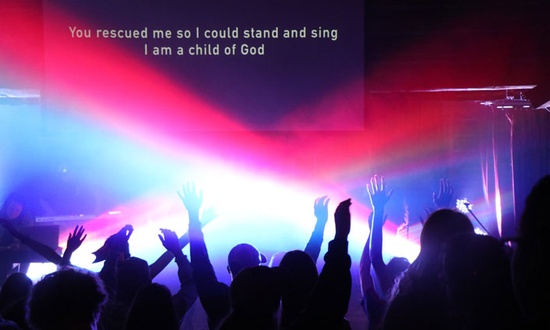

The Bible is full of examples of people praising God with singing and musical instruments. In the Temple—a representation of God’s presence—288 people sang and played a variety of instruments (1 Chronicles 25:1-8). The psalmist instructed the people to praise God with trumpets, harps, lyres, tambourines, strings, flutes, and cymbals (Psalm 150). Hezekiah said, “We will sing with stringed instruments all the days of our lives in the temple of the Lord” (Isaiah 38:20). Jesus sang with His disciples (Mark 14:26), and the apostle Paul instructed Christians to sing to the Lord (Ephesians 5:19). James says, “Those who have reason to be thankful should continually sing praises to the Lord” (James 5:13, NLT).
The 144,000 “who had been redeemed from the earth” sing a “new song” before God’s throne (Revelation 14:2-3). Moses’ song, likely the song of Exodus 15, might be on the lips of God’s saints in Heaven. Revelation 15:3, describing John’s vision of Heaven, says, “They were singing the song of Moses, the servant of God, and the song of the Lamb, saying, ‘Great and marvelous are your works, O Lord God, the Almighty. Just and true are your ways, O King of the nations.’”
Will songs we know be in Heaven?
Scripture songs will endure, but other music from Earth may also be preserved. If we sing songs in Heaven that were once sung on earth, perhaps we’ll also sing the hymns of people like Isaac Watts, Charles Wesley, and John Newton. Consider Handel’s Messiah, Luther’s “A Mighty Fortress Is Our God,” the black spiritual “Swing Low, Sweet Chariot,” and Isaac Watts’s “Alas! and Did My Savior Bleed?” What about the thousands of great hymns and praise songs from hundreds of cultures? Imagine a remote tribe singing praises in a beautiful language you’ve never heard.
Although some lyrics will require theological corrections, others will be suitable as is, ready to be sung in God’s presence. Just as new songs will express old and new insights about God, the old songs will express earthly insights that in the context of Heaven will have a greater depth of meaning.
Will secular songs survive? Not if they dishonor Christ. But what about songs that cried for perspective and deliverance? We might recall and even sing such songs to remind us of when we longed for God and when he answered. Maybe other old songs, less deep but not sin-corrupted, will be sung just for fun. Which of your favorite songs will survive the fire? (If there’s a specific reason why some won’t, why listen to them now?)
We will also sing “new songs” in Heaven (Revelation 5:9; 14:3) and on the New Earth (Isaiah 42:10). This suggests that some of God’s people may serve as songwriters, eternally lending their talents to the praise of God.
Music is transcendent—a bridge between this world and another. That’s why people devote so much of themselves to it and gain such pleasure in it. We love the rich and varied rhythms and harmonies. In Heaven God will unleash our creativity, not confine it. As a musical novice, I might compose something worthy of Bach. (And what kind of music do you suppose Bach will compose?!)
Will we always be on our faces at Christ’s feet, worshiping Him?
No, because Scripture says we’ll be doing many other things—living in dwelling places, eating and drinking, reigning with Christ, and working for Him. Scripture depicts people standing, walking, traveling in and out of the city, and gathering at feasts. When doing these things, we won’t be on our faces before Christ. Nevertheless, all that we do will be an act of worship. We’ll enjoy full and unbroken fellowship with Christ. At times this will crescendo into greater heights of praise as we assemble with the multitudes who are also worshiping Him.
Someone might ask, will we have to sing even if we don’t like to? The question assumes facts not in evidence—that whatever we dislike now we’ll dislike then. But doesn’t experience tell us otherwise? Aren’t there foods we love now that we hated as children? Aren’t there books we love now that would’ve bored us when we were younger? Had we been able to decide as children everything we would do or not do as adults, wouldn’t we have robbed ourselves of countless joys? We mustn’t assume that everything we don’t like doing now we still won’t like doing in Heaven.
In Heaven, where everyone worships Jesus, no one says, “Now we’re going to sing two hymns, followed by announcements and prayer.” The singing isn’t ritual but spontaneous praise (Revelation 5:11-14). If someone rescued you and your family from terrible harm, especially at great cost to himself, no one would need to tell you, “Better say thank you.” On your own, you would shower Him with praise. Even more will we sing our Savior’s praises and tell of His life-saving deeds!