
On a flight out of my hometown of Portland, Oregon, I struck up a conversation with the passenger seated beside me. I asked her about her work, and she in turn asked about mine. When I said, “I’m a writer,” she wanted to know about my books, so I told her about a few novels and mentioned I had also written nonfiction. But when I said I’d written books about Heaven, her body language changed, and she appeared very uncomfortable. My “religious” reference shut down the conversation. I wasn’t entirely surprised, because Portland has the highest percentage of people in the US without any religious affiliation—9 percent higher than San Francisco and Seattle, the nearest runners-up.8
In an effort to revive the conversation, I asked, “Do you have any pets?” Suddenly, her face brightened. “Yes, I have a dog!”
She showed me a photo, happily telling me all about him. I showed her a picture of my dog and shared how much my wife and I loved animals. I mentioned that two chapters in my big book about Heaven address whether animals, including our pets, might have an afterlife.
She looked at me wide-eyed. “Are you saying you believe there will be animals in Heaven?” I briefly explained the Bible’s teaching about the new creation and God bringing Heaven down to the New Earth, where many different animal species will live together peacefully with people. Just minutes earlier, she had disengaged at the very mention of Heaven. But now we were talking not just about animals, but about Jesus—the central figure of Heaven and the only way to get there.
Like many people I’ve met over the years, Christian and non-Christian alike, this woman had never heard of the biblical doctrine of the New Earth—a beautiful, restored planet with all its current wonders and much, much more, yet without evil or suffering. The prospect of such a place, a true Earth that included animals, moved her from disinterest in the afterlife to genuine curiosity.
Many people distrust organized religion but love animals and the natural world. They don’t know God, yet they cherish what He created. They catch glimpses of Him in nature (Romans 1:19-21). Their love for animals flows from being God’s image-bearers and can be a bridge to the gospel. Why? Because the God who created them also made the animals they adore.
Scripture tells us Jesus went to the cross primarily for humans, but also for the good of His entire creation: “Through him God reconciled everything to himself. He made peace with everything in heaven and on earth by means of Christ’s blood on the cross” (Colossians 1:20).
God’s love for animals and His plan to restore all creation is a major biblical theme, though many believers haven’t yet grasped it—or, worse yet, have never heard it. For me, embracing this truth brings paradigm-shifting joy, which explains why the devil has worked so hard to hide what the Bible says about Heaven, even from those who regularly attend church.
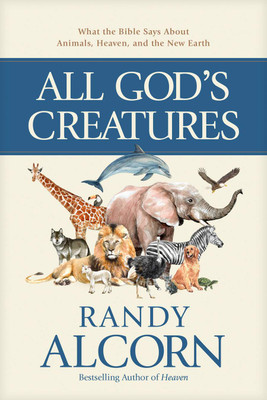
That’s why I’m so excited about my latest book All God’s Creatures: What the Bible Says About Animals, Heaven, and the New Earth, which will be released from Tyndale House on November 17, 2026. It’s been many years since I’ve been this enthusiastic about one of my books! A large part of my excitement is that it is truly unique. There are many self-published and warm-hearted books about animals in Heaven, but they lack serious treatment of the biblical texts or the arguments throughout church history. Perhaps because of our biases, and partly because seminaries don’t address it, for pastors the subject of animals in Heaven is outside the box of orthodox thinking.
But it’s a biblical fact that God has revealed Himself in His creation, and we can see Him through it, even though creation is fallen. After human beings—the only creatures made in God‘s image—His next most important self-revelation is in animals—the other sentient beings in our world. The attention they get in Genesis 1–2 and again in Genesis 6–9 should clue us in to that.
As I was researching the book, I read Job 38–41 repeatedly. In all the times I had read those chapters before, never once had it sunk in that while Job is struggling with the problem of suffering, God’s response is His longest monologue in all of Scripture—a lengthy self-revelation—20% of which is about the inanimate wonders of His creation and 80% of which is about animals. I had long been struck with God’s obvious admiration for the horse and other animals, including Behemoth and Leviathan, but I never noticed that of all the topics He could’ve shared to win Job over, He chose to talk about animals! God’s revelation somehow brings Job to his knees in wonder and repentance. Clearly, God sees something in His animals beyond what many believers do today.
It’s ironic that the only theologians who talk most seriously about animals are liberal, but they import evolutionary assumptions and reason instead of appealing to God’s Word. I think the conservative overreaction, minimizing animals, is partly due to the liberal proclivity toward embracing evolutionary theory. Several wonderful conservative theologians, whom I admire and usually agree with, have argued, “Animals aren’t made in the image of God and therefore, have no place in the world to come.” Try telling that to the angels!
I haven’t asked for book endorsements for 15 years or so, but with All God’s Creatures I knew I would be swimming upstream with some readers who might not take a theology of animals seriously. Max Lucado and Sean McDowell graciously offered these endorsements:
Randy Alcorn’s books have blessed my life for decades. His volume Heaven guided me from a vague, ethereal perspective to an exciting view of the life to come. My copy is underlined, highlighted, and dog-eared! I have the same enthusiasm for All God’s Creatures. It specifically addresses the question of animals on the New Earth by explaining the promise of Scripture regarding our eternal home. Prepare to be informed, inspired, and empowered. Thanks, Randy for this brilliant work.
Max Lucado, pastor; author of Tame Your Thoughts
Do animals have souls? Will they be in Heaven? Why does God allow animals to suffer? In All God’s Creatures, Randy Alcorn’s answers—based on Scripture texts—might surprise you. You may disagree with some of his conclusions, but you will undoubtedly enjoy his insights and be guided to wrestle biblically with these important questions. I love this book and believe you will too.
Sean McDowell, PhD, professor of apologetics at Talbot School of Theology, author; popular YouTuber
If, like me, you were never taught a theology of animals but would like to learn, I hope All God’s Creatures guides you a good distance on that journey!
Note from Eternal Perspective Ministries: You can now preorder All God’s Creatures from EPM, and your book will ship by media mail when it releases this fall.