
The following is an interview I did with Operation Mobilization (OM), an organization Nanci and I have loved for years, and which EPM highly recommends.
How did you first get connected to OM?
I had long been aware of George Verwer and knew many people who had worked on OM’s ships, but then George and I spoke together at a pastor’s conference that John Piper put on with Desiring God many years ago. George was George, and he won my heart over. We became dear friends, and like countless other people, I would receive phone calls from him from all over the world, including once while he was crossing the Atlantic on a ship. One week it would be somewhere in India. The next week he would say, “I’m calling from a church parking lot in Scotland.”
George and I did a dialogue on joyful giving in Portland, Oregon, and we spoke at multiple other places together. He also came to my home church and did a missions conference. At the time, our church had six weekend services: three Saturday night and three Sunday morning. Our pastors always preached the same message for each service, but George, of course, preached six different messages! (Which really confused our small groups because they would discuss the weekend messages on the assumption they were all hearing the same one!)
Over the years, I’ve gotten to know many OM people and have loved my relationships with them. I spoke at a couple of OM donor conferences, including one in Jamaica, and my wife, Nanci, and I stayed on Logos Hope for five days. We sat at a table where no two people came from the same country — it was unlike anything that we had ever experienced, and it was delightful.
Before leaving the ship, I asked the leaders, “Is there something more we could do to encourage the crew?” They told us about their upcoming annual sabbatical week and said, “We were hoping we could go out and take everybody to this island and go snorkeling, but it’s just not affordable.”
I love snorkeling, so with joy in our hearts, Nanci and I committed a portion of my book royalties to pay for a day of snorkeling and fun for the whole crew. A few weeks after we left, they went to the island for their sabbatical. Afterward we received letters and e-mails from some of the crew telling us what an amazing and unforgettable experience it was.
After Nanci passed away, Logos Hope kindly dedicated their library to her, naming it the Nanci Alcorn Memorial Library. OM is very, very close to my heart. I remember one year when we gave 25,000 books away to the ship ministry, and we still provide them with books. Where else could you give 25,000 books and feel like it was a win-win all around?
You didn’t grow up in a Christian family. What was one of the first times you recognized someone reflecting Jesus in their actions toward you?
My dad was 47 years old when I was born and was hostile to the gospel. Because of his profession as a tavern owner, he wasn’t popular with Christians, particularly in those days. My mom was wonderful, probably the only unbeliever I knew who was so kind that it was like she knew Jesus. But sadly, nobody in my family was happy. This was a second marriage for both my parents. Every time Dad came home in the middle of the night and he and Mom yelled at each other, I lay in bed wondering whether this fight would end in divorce.
I started going to church to see a girl, Nanci, who eventually became my wife. (I do not recommend missionary dating as a strategy for evangelism!) But a year after I met Nanci, I came to faith in Jesus through reading the Bible, as the words of Jesus penetrated my heart.
The youth pastor at that church, Paul Siwick, saw my passion for books. I would go into his library at the church office, pull books off the shelf, and ask, “Do you mind if I sit here and read?” He encouraged me, so I’d spend hours reading great Christian books. I was amazed that this man trusted me enough to eventually give me a key to his office! His example of Christlikeness—generosity, kindness—made a huge impression on me.
How do you seek to imitate Jesus in everyday life?
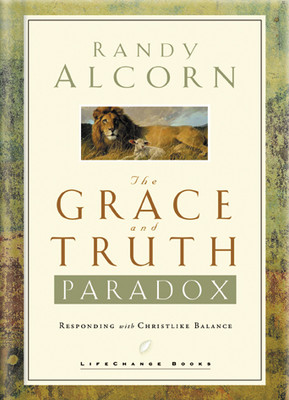
My book The Grace and Truth Paradox is probably my favorite non-fiction book I’ve written. That book gives a two-point checklist of Christlikeness. There are nine Fruit of the Spirit listed in Galatians 5, but by the time you get to the end of the list, you’ve forgotten what was at the beginning! You can’t think simultaneously of all of them. You can, however, fix your mind at the same time on two things: Jesus came full of grace and truth. So in seeking to follow Jesus and become more like Him, I’ve focused on reflecting His grace and truth.
Years ago, Nanci and I went to see a movie with friends. When we got in our car afterwards, we saw a man driving erratically all over the parking lot. I told Nanci, “I’ll bet he’s an insulin-dependent diabetic with low blood sugar.” I’m insulin-dependent, so we know what that looks like. He was trapped in a parking lot, and it was dangerous because he was going too fast. When he finally stopped long enough, I came up to his car and said, “Could I drive you home? I’m guessing you have low blood sugar.” He nodded, so I drove him to his place, got him settled in, made sure he ate something to raise his blood sugar, and once he was thinking straight, shared the gospel with him.
What’s extraordinary is that that he had been a sociology professor for decades at San Francisco State University, a place that is largely anti-gospel. I met with him several more times, and he ended up placing his faith in Christ. My desire was to reach him with the truth, but the avenue through which the truth traveled was grace. I had taken the time to do something kind for him, and he didn’t understand why. His barriers against the gospel were swept away by an act of grace.
When has it been a challenge to imitate Jesus, and what has helped you stay close to God during times of deep struggle?
My time in prolife ministry, which was an important part in my life, comes to mind. Over forty years ago, another pastor and I started a church together. After 14 years, the church was rapidly growing. During that time, I started doing pro-life work with the permission of the elders at my church. That included going down to abortion clinics and standing in front of doors, sometimes holding up a sign saying, “Please let your child live.” We were doing peaceful, nonviolent civil disobedience. But in Portland, Ore., it was not an accepted practice. The clinic brought an $8.2 million lawsuit down on a group of about 20 of us.
I was on the front page of The Oregonian, the most prominent newspaper in the state of Oregon, standing outside an abortion clinic with an open Bible, reading it. The level of hostility toward those of us involved is hard to describe. Like many others, I was arrested on a number of occasions and went to jail for a couple days.
So how do you treat people who hate you? (And hate is not too strong a word for what we experienced.) Of course, the people at the abortion clinics hated us. The people on the jury were taught to hate us by the accusations, most of them false, that were brought against us. But what was especially difficult was that sometimes fellow believers were almost as hostile toward us as the unbelievers.
How do you deal with that kind of adversity and display Christlikeness? It comes back to grace and truth. You tell the truth, and you do it in the spirit of grace. You don’t get angry at the people who believe false things about you.
One of the greatest things God taught me through those years was I didn’t need to be liked by others. I will stand before the Lord. And on that day, it will not matter whether I have people’s approval or disapproval. What will matter is, has God approved of me and my life? In the end, no matter what judgment is passed on me (or praise is offered me) by believers or unbelievers, it is Christ’s evaluation that matters.
Several of your books focus directly on Jesus. How has writing these books impacted your relationship with Him?
It has profoundly affected my relationship with Christ. For me, it’s impossible to separate the work that I do from my walk with God. If writing were not a true ministry, I wouldn’t do it. But it is.
Sometimes being a writer can be lonely. But I’ve learned more about honoring Christ and drawing near to Him through writing than through almost anything else. When I write, it is just me and the Lord, and I call on Him for help and strength.
In one sense, all of my books are about Jesus, but some of them are particularly so, and writing those books changed me. You become more Christlike when you meditate on Christ and who He is. The longer you gaze at His image portrayed in Scripture, the more you become transfixed, and the more you grow to reflect His likeness.
Why is generosity important to you?
Because we give all the book royalties away, everything I write will produce an income that will go in its totality to Christian ministry. (Nanci and I learned to give together, so I always say “we” even though she’s been home with the Lord for four years.)
Through giving, I have vested interests in God’s work all over the world, including children being liberated from sexual abuse and slavery, and young girls and boys being delivered from the most horrific things on the planet. To know that I have had a part in that through giving brings me such joy. There’s nothing like getting the gospel to people who have never heard it and providing clean water to children to save their lives. Knowing that one day I will likely see those people in the presence of Jesus overwhelms me with gratitude.
I say in my books on giving that God’s grace is lightning, and our giving in response is the thunder. Wherever there is lightning, there is thunder. The lightning of God’s grace should radically transform our thinking and renew our minds and make us into the kind of people who instinctively give. He keeps giving to us, and we have the opportunity to give back to Him again. (Yet we can never outgive Him!)
If you experience God’s grace, that will inevitably overflow into giving money, and also giving your time, talents, and abilities. We give as an act of grace because we have received so very much from God.
Jesus said in Acts 20:35 that it is more “happy-making” to give than to receive. The Greek word is translated into English as “blessed,” which makes it sound like it’s all about holiness, but it actually means “happy-making.” I found an 1829 copy of Webster’s Dictionary and looked up what “blessed” means. It meant “happy”! I can attest to the truth of this verse. There’s nothing Nanci and I could have done with those royalties that would have brought more joy and happiness to our hearts than giving them to God’s Kingdom.
One of the ministries that Eternal Perspective Ministries gives to regularly is OM. We do so joyfully, knowing that money is well invested in God’s Kingdom. Much of that is due to George Verwer and Dale Rhoton, who set a standard. There are many ministries that have departed from how they were founded, but everything that I’ve seen in OM indicates that the heart and soul of the founders are still reflected in what the ministry does. That gives me an extraordinary amount of confidence in OM’s work.